Automation and robotization in construction
Automation and robotization in construction – how automation changes work at height
Why is automation on construction sites crucial?
How does the robotic assembly system work?
Efficiency and savings thanks to robotics
Precision that can’t be achieved by hand
Intelligent reporting and data analysis
The future of automated construction
Automation and robotization in construction - how automation changes work at height
Construction work at height is one of the most demanding tasks in the industry. Installing glass panel supports at a height of up to 300 meters above the ground requires great precision and at the same time involves a risk to the health and life of employees. The American company Harmon Inc., a leader in the glazing industry, decided to introduce innovative technological solutions that not only increase safety, but also speed up and facilitate the entire process. Working with Raise Robotics and Universal Robots, Harmon has introduced automation that is revolutionizing the way work at heights is performed.
Why is automation on construction sites crucial?
Traditionally, bracket installation work required workers to perform precise tasks in hazardous conditions. They had to drill, align and tighten elements on the facades of skyscrapers, often hanging from the side of the building. Any mistake – such as dropping a tool or bracket – created a risk of serious injury to both workers and those on the ground. Harmon emphasizes that safety always comes first. Effective execution of work while eliminating risk is a solution that would gain the approval of every contractor. Automation allows employees to stop working at heights and use robots in much more comfortable and safer conditions
How does the robotic assembly system work?
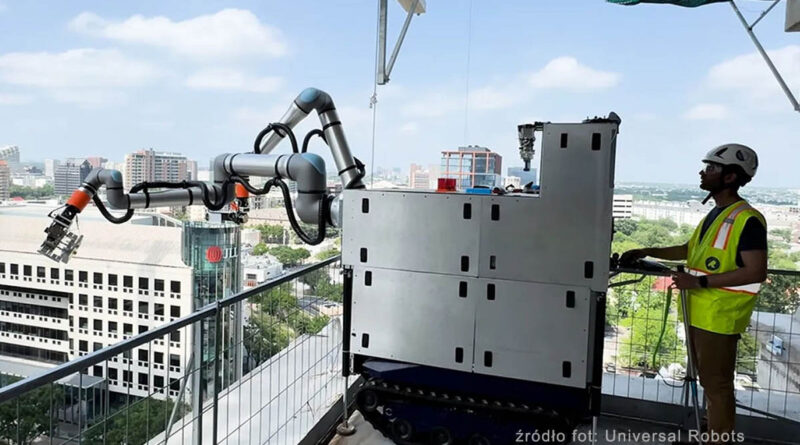
Raise Robotics, in cooperation with Universal Robots, has created a construction platform based on two UR20 robotic arms. These collaborative robots, called cobots, were mounted on a mobile base. Thanks to their small size and energy efficiency, it was possible to create a system that operates wirelessly, which is crucial on construction sites.
UR20 cobots are designed to work in difficult conditions. Their high resistance to dust, moisture and temperature extremes ensures the system operates reliably in all circumstances – from a frigid -20°F to a scorching 120°F. In addition, the platform uses advanced software that allows monitoring the installation process in real time. Thanks to this, each bracket is mounted with maximum precision.
Efficiency and savings thanks to robotics
The introduction of robotics on construction sites brings not only greater safety, but also significant savings. As Conley Oster, co-founder of Raise Robotics, points out, the traditional assembly process required the involvement of two to four workers. Now one person is enough to operate the robot. This means a threefold increase in work efficiency.
Thanks to automation, Harmon saw a quick return on investment. The work pays off during the construction of the project, which covers only 13 floors. Their speed and accuracy not only reduce labor costs, but also minimize errors that could lead to costly rework.
Precision that can't be achieved by hand
One of the most important aspects of robots’ work is their ability to perform tasks with extreme accuracy. Traditional, manual assembly methods often led to errors – as many as 30% of the brackets could be placed incorrectly. Thanks to the robotic system, the brackets are installed with an accuracy of three-sixteenths of an inch. This is a result that cannot be achieved in a traditional way. Precise placement of mounting elements is not only about aesthetics and quality of workmanship. Thanks to total stations integrated with the system, robots can work equally effectively both on the edge of the building and in its internal parts.
Intelligent reporting and data analysis
The introduction of robotics to construction is also a step towards the digitization of construction processes. The system developed by Raise Robotics offers reporting functions that provide detailed data on each stage of the installation. The software records torque and alignment information for each bracket in real time. Thanks to this, contractors can constantly monitor the progress of work and quickly identify and eliminate any deviations from the specifications. Detailed reports allowed the team to make corrections before installing the glass panels, which significantly sped up and streamlined the entire process. Early detection of deviations made it much easier to eliminate them at later stages of work
The future of automated construction
The solutions introduced by Harmon, Raise Robotics and Universal Robots show how much potential there is in construction automation. Thanks to robotics, work at heights becomes not only safer, but also more effective and precise. The introduction of cobots to construction sites is an example of how technological innovations can transform even the most demanding processes. Automation opens new opportunities for the construction industry. Employees can focus on more creative tasks, leaving repetitive and dangerous work to robots. Harmon Inc. proves that technology not only increases efficiency, but also brings tangible financial and organizational benefits.