Unitree G1 Humanoid Robot as the Home Helper of the Future
The Unitree G1 Humanoid Robot Opens the Way to a New Everyday Life
A Design That Combines Lightness with Strength
Impressive Parameters
Sensors That See the World in Three Dimensions
Software That Adapts the Robot to New Tasks
Home Applications That Are No Longer Fantasy
Accessibility That Changes the Humanoid Market
Challenges That Still Need to Be Addressed overcome
Education and development gaining a new dimension
Will everyone be able to buy a home humanoid?
The Unitree G1 humanoid robot opens the way to a new everyday life
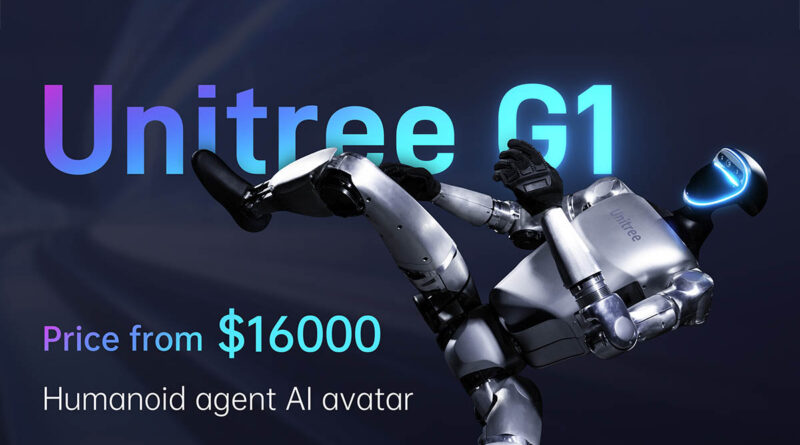
The Unitree G1 humanoid robot until recently seemed destined solely for laboratories and advanced research centers. Today, it’s beginning to attract interest from users who envision it as a future home assistant. The question arises whether humanoid robots are truly becoming a technology accessible to everyone, and whether the G1 might one day perform everyday tasks in the living room, kitchen, or home workshop. The robot already impresses with its fluidity of movement, stable gait, and manipulation capabilities, bringing it closer to real-world service tasks.
A design that combines lightness with strength
One of the Unitree G1’s greatest strengths is its body. Designers focused on lightweight materials to ensure the robot moves energetically and dynamically while maintaining stability during complex maneuvers. The harmonious combination of low weight and the power of the motors in the joints allows for quick turns, speed changes, and precise arm movements. The G1 also folds, making it easy to transport between test stations or store in a room at home without taking up much space. The increased degrees of freedom enable complex movement sequences that bring it closer to human physical capabilities.
Impressive parameters
G1 has humanoid proportions and a compact height of approximately 132 centimeters. It weighs approximately 35 kilograms, making it lighter than most full-size humanoids on the market. Its servos generate high torque, and its top speed while walking allows for smooth navigation in living or workshop spaces. The robot can perform micro-movements of the hand, and optional grippers allow it to pick up and place objects. The power supply is sufficient for most research tasks, and operating time can be extended with replaceable batteries.
Sensors that see the world in three dimensions
The Unitree G1 humanoid robot utilizes an advanced set of depth cameras and sensors that create a three-dimensional image of its surroundings. This allows the robot to not only capture colors and shapes but also, more importantly, understand distances, obstacle positions, and terrain structure. Its software enables near-real-time visual data processing, while machine learning algorithms help assess risk, determine trajectories, and correct movement during gait. This precision allows it to maintain balance on uneven surfaces and avoid collisions with furniture and equipment.
Software that adapts the robot to new tasks
G1 was designed as a modular platform, meaning its functionality depends primarily on software. The system’s architecture allows for the installation of new packages for tasks such as object manipulation, image analysis, spatial exploration, and human interaction. Researchers develop their own algorithms, students test new perceptual solutions, and robotics enthusiasts teach the robot to execute simple commands. Thanks to this approach, G1 is not a closed product, but a constantly evolving platform. Each update increases its potential and brings it closer to becoming a home assistant.
Home Uses That Are No Longer Fantasy
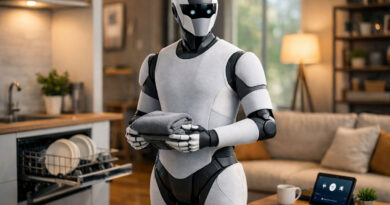
Although the current generation G1 was designed primarily for research, many of its features suggest that humanoid robots could one day perform basic household chores. Its stable gait, precise arms, and ability to respond to environmental changes provide the foundation for tasks such as carrying lightweight objects, cleaning confined spaces, easily operating tools, and supporting individuals with limited mobility. If manufacturers add additional intelligence modules and extend battery life, such functions could become feasible beyond laboratories.
Accessibility is changing the humanoid market
Humanoid designs have traditionally been prohibitively expensive and require dedicated laboratories. The Unitree G1 reduces this barrier, designed with efficiency and mass production in mind. Its price remains high for the average user, but it’s low enough for the platform to be available to many universities, startups, and tech companies. In practice, this means significantly broader access to advanced robotics. The increased user base accelerates the development of new algorithms and shortens the path to versions that could one day become consumer models.
Challenges still to be overcome
The G1 continues to grapple with the limitations that have plagued humanoid robots for years. Stability in extremely difficult terrain can be a challenge. Integration with external systems requires experience. Service requires knowledge beyond basic technical acumen. At the same time, each of these challenges provides grounds for further research and project refinancing. The humanoid market is developing rapidly, and each year sees greater automation, longer operating times, and greater precision.
Education and development that gains a new dimension
One of the most important impacts of G1 on the world of technology is its educational role. Students learn programming and robotics there, while also understanding the mechanical constraints that distinguish the digital from the physical world. Researchers use it to test algorithms that are later incorporated into robotic production lines, autonomous systems, and medical technologies. G1 connects teams from various fields and creates a development platform that inspires future creators.
Will everyone be able to buy a home humanoid?
The Unitree G1 humanoid robot marks the direction in which the robotics market is heading. If subsequent generations are cheaper and more autonomous, a humanoid in the home could become as natural as a smart vacuum cleaner or a voice assistant. Today’s models explore the environment and learn to respond to real-world situations. Tomorrow, they could prepare a simple snack, organize a shelf, or assist with daily tasks. The G1 is one of the most important steps in this process.
The Unitree G1 combines advanced mechanics, sensors, and modern software in a compact platform that changes the way we think about humanoid robots. This robot already supports research and education, and in the future, it could play the role of a home assistant. Its development indicates that the era of humanoids in everyday life is closer than we think. If the evolution of robotics maintains the pace of recent years, the vision of a home humanoid will cease to be a dream and become a natural part of modern life.
source:https://www.unitree.com/g1