Functional Materials in Modern Industry: Engineering and Operational Importance
Engineering Context and the Importance of Functional Materials
Functional Materials vs. Classical Construction Materials
Degradation Mechanisms as the Basis for Material Selection
Functional Coatings and Self-Healing Systems
Ceramic Composites (CMC) and High-Temperature Resistance
Limitations of Functional Materials
Life Cycle Cost as a Decision Criterion and Development Directions
Engineering Context and the Importance of Functional Materials
The development of modern industrial processes means that material selection criteria go beyond classic mechanical strength. Resistance to wear, corrosion, high-temperature degradation, and parameter stability over time are becoming increasingly important. Functional materials—particularly engineering coatings and ceramic composites—enable the design of components with increased durability and reduced life-cycle costs for industrial installations.
Functional materials vs. classic construction materials
Structural steels offer a favorable strength-to-cost ratio, but they are susceptible to corrosion in chemically aggressive environments and to creep and oxidation at elevated temperatures. Structural polymers are chemically resistant but have limited thermal stability and susceptibility to aging.
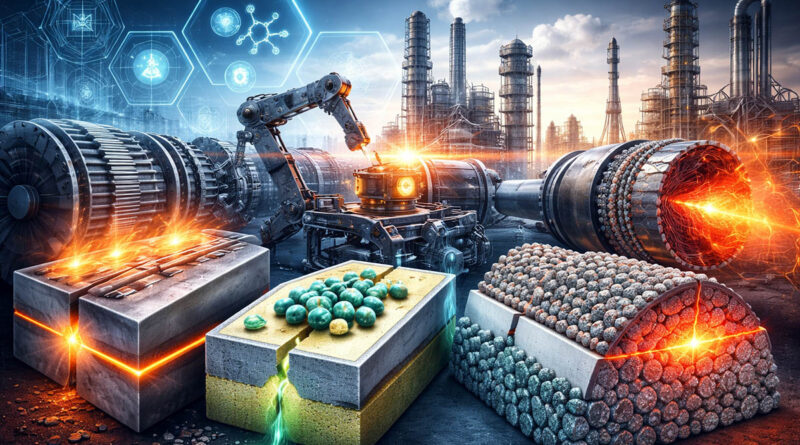
Functional materials do not directly replace structural materials, but modify their surface or structural behavior. Examples include ceramic and metallic coatings, which increase resistance to abrasion, corrosion, and oxidation while maintaining the strength of the structural core. This approach allows for the design of components as layered systems with diverse functions.
Degradation mechanisms as a basis for material selection
The selection of functional materials is based on an analysis of the dominant degradation mechanisms. In the power generation and gas turbine industries, creep, thermal fatigue, and oxidation are key. In the chemical industry, electrochemical corrosion and corrosive erosion dominate. In solids transport systems, abrasive wear is crucial.
Coatings and functional materials are designed to limit specific degradation pathways – by creating diffusion barriers, increasing surface hardness, or improving chemical stability. The effectiveness of such solutions stems from controlling degradation mechanisms, not simply from increased overall strength.
Functional coatings and self-healing systems
Modern coatings produced using PVD, CVD, or plasma spraying methods significantly increase surface resistance to wear and corrosion. Properly selecting the coating’s chemical composition and microstructure helps reduce oxidation and wear in high-temperature conditions.
Self-healing systems are also being developed, in which microcapsules or reactive polymer components release repair substances at the site of microdamage. This mechanism can slow down defect propagation and extend the coating’s service life, but its effectiveness is primarily limited to microcracks.
Ceramic Composites (CMC) and High Temperature Resistance
Ceramic matrix composites (CMCs) combine the high thermal resistance of ceramics with greater damage tolerance thanks to the use of reinforcing fibers. They are used in components operating at elevated temperatures, such as gas turbine components. They are characterized by high chemical stability and oxidation resistance while being lighter than traditional high-temperature alloys.
Functional Material Limitations
Ceramic coatings can be brittle and sensitive to mechanical impact. Self-healing systems do not replace structural repairs in the event of major damage. CMC composites require advanced production technologies and quality control, which increases manufacturing costs. Therefore, the use of functional materials requires not only material expertise but also the technological capabilities of the plant.
Life cycle cost as a decision criterion and development directions
Functional materials often increase the initial cost of a component, but they also reduce operating costs by reducing downtime, extending maintenance intervals, and ensuring stable operating parameters. In applications with high downtime costs, life-cycle cost analysis justifies their use.
Current research focuses on multifunctional materials that combine corrosion, wear, and temperature resistance, as well as integrating sensor functions to monitor material condition. The material becomes a component of a diagnostic system, not just a passive part of the structure.
Functional materials in industry are most widely used in environments where high temperatures, aggressive environments, and high downtime costs coexist. Their importance stems from their ability to control degradation mechanisms and impact the life-cycle cost of the installation. They do not replace traditional construction materials, but rather expand the design possibilities of modern engineering.
Bibliography
Ghosh S.K. (ed.). Self-Healing Materials: Fundamentals, Design Strategies, and Applications. Wiley;
Davis J.R. (ed.). ASM Handbook, Volume 5: Surface Engineering. ASM International;
Callister W.D., Rethwisch D.G. Materials Science and Engineering: An Introduction. Wiley;
Krenkel W. Ceramic Matrix Composites: Fiber Reinforced Ceramics and Their Applications. Wiley-VCH.