Technologies are transforming food production.
What does the factory of the future look like?
Technologies are transforming food production from the shop floor to the warehouse
Artificial intelligence is not replacing production
Safety, quality, and less food waste
The factory of the future needs people, not just machines
What does the factory of the future look like?
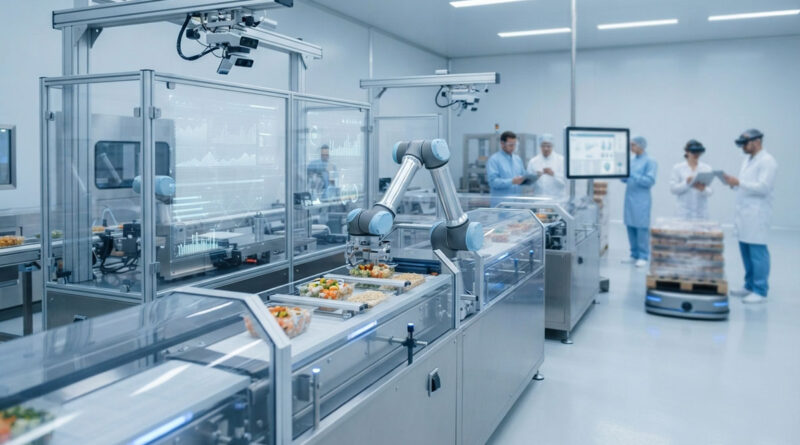
Technologies are transforming food production faster than some in the industry anticipated just a few years ago. Automation, robotics, artificial intelligence, vision systems, and data analytics are no longer solutions associated solely with the automotive industry; they are increasingly making their way into food processing plants. However, their purpose is not merely to replace human workers on the production line. Above all, modern technologies aim to enhance process consistency, improve quality control, minimize waste, and enable manufacturers to respond more swiftly to changing market conditions.
The scale of this transformation is also evident in data concerning Polish industry. According to Statistics Poland, the value of sold production in the “manufacture of food products” sector rose by 6.8 percent in 2025 compared to 2024. During the same period, labor productivity across Polish industry as a whole increased by 3.5 percent, while average employment fell by 0.5 percent.
This does not mean, of course, that every food factory will become fully autonomous. The food industry has unique requirements: it deals with biological raw materials, high product variability, stringent hygiene and safety standards, and cost pressures. Consequently, the future will not belong to any single technology; rather, it will be defined by a combination of machinery, data, and human expertise.
Technologies are transforming food production from the production floor to the warehouse
Automation remains the most visible element of this transformation. In food processing plants, it can encompass tasks such as raw material dosing, mixing, internal transport, sorting, packaging, palletizing, and process parameter monitoring. A robot does not necessarily have to handle the entire production process; often, it takes over a single, repetitive stage that previously required constant human labor.
This is particularly important where a high volume of repetitive operations is involved. A robot can perform the same task for hours on end while maintaining a consistent level of precision. Meanwhile, the control system can continuously record process parameters and transmit them for further analysis.
A European overview of robotics, artificial intelligence, and automation in the food sector indicates that these technologies are applied across many stages of the value chain. This includes production and processing, packaging, warehousing, and distribution, as well as selected areas of food services. The development of such solutions is driven by factors such as the need for greater efficiency, safety and quality requirements, and challenges regarding labor availability.
In practice, this entails a shift in how automation is approached. It is no longer solely a matter of purchasing a specific machine; manufacturers must determine which part of the process is truly worth automating.
For one plant, robotizing the packaging process might yield the greatest benefit. In another, automated raw material dosing might be more significant. Yet another manufacturer might primarily require a system to monitor temperature, humidity, or storage conditions.
The robotization of internal logistics also plays a significant role. Automated transport systems can move products between successive production stages and the warehouse. This reduces the number of manual operations and enables better control over the flow of goods.
At the same time, digital technologies make it possible to interconnect the various elements of the factory. Machines no longer operate as completely independent units; data from equipment, sensors, and production systems can be fed into a shared analytical environment. Only then does the enterprise begin to see the full picture of the process.
This is one of the foundations of the Industry 4.0 concept.
Artificial intelligence does not replace production
Artificial intelligence represents the second pillar of this transformation. In the food industry, its application is far broader than the term “AI” alone might suggest.
Algorithms can analyze large datasets from production, help predict outcomes, control quality, and optimize logistics processes. A European overview of AI applications in the food sector highlights, among other things, the use of AI for supply chain optimization, demand forecasting, waste reduction, and the monitoring of food quality and safety.
Vision systems offer distinctive capabilities. A camera can analyze products moving along a production line; software inspects their appearance and can detect potential defects.
Such solutions can be applied to packaging sorting, packaging inspection, and product verification. While humans remain part of the process, they do not need to manually handle every single product moving rapidly along the conveyor belt.
AI can also be applied to maintenance operations. Analyzing machine data allows for the detection of warning signs. For instance, it can identify issues before a breakdown occurs or before a component fails.
Predictive capabilities can offer significant economic value. Unplanned production line downtime entails more than just repair costs; it can lead to logistical complications and the need to reorganize workflows across the entire facility. One application involves creating “digital twins”—virtual replicas of actual processes, individual machines, or entire system sections. This tool analyzes system performance and simulates changes without requiring immediate physical intervention.
For manufacturers, this opens up the possibility of asking highly specific “what-if” questions: What happens if parameters are changed? Where will a bottleneck emerge? Does a new machine offer improved throughput? How can energy usage be optimized?
The more data available, the greater the potential value of its interpretation.
However, this does not mean that artificial intelligence automatically solves all business problems. Effective use of data requires appropriate algorithms, clearly defined objectives, and human oversight. Flawed or incomplete data can lead to erroneous conclusions.
Digitalizing production requires more than just investment in software; it also demands the right skills and expertise.
Safety, quality, and less food waste
In the food industry, automation has yet another dimension: product safety.
EU regulations require companies to be able to trace the path of food and its ingredients through the successive stages of production, processing, and distribution. Traceability makes it possible to identify the source of a problem more quickly and withdraw defective products from the market more efficiently.
Digital systems can significantly facilitate this task. Data regarding raw material batches, production, and distribution can be collected and integrated in a way that makes it easier to reconstruct a product’s history later on.
The importance of digital traceability is also well illustrated by the EU’s TRACES system. The European Commission reports that in 2024, over 5.4 million official documents were issued and transmitted via the platform, with approximately 100,000 users from EU bodies and non-EU countries utilizing the system. The platform aims to streamline the exchange of data, documents, and information while supporting traceability across the agri-food supply chain.
Going even further is TraceMap, a European Commission tool that uses AI to analyze data related to the agri-food supply chain. The system helps identify connections between operators, products, and shipments, as well as detect potentially suspicious patterns.
Thus, technology can support not only the factory itself but also the monitoring of the entire supply chain.
The factory of the future needs people, not just machines
Automation does not signal the end of human labor in the food industry; rather, it transforms the nature of the work.
Workers increasingly do more than just perform repetitive tasks; they operate systems, analyze data, respond to alarms, oversee equipment, and make decisions. This requires a different set of skills compared to traditional assembly-line work.
The European “Pact for Skills” initiative for the food industry highlights how digitalization is reshaping production models through the use of technologies such as robotics, AI, the Internet of Things (IoT), and machine learning. This shift drives a growing demand for new workforce skills.
Indeed, workforce skills may well prove to be one of the greatest challenges of this transformation.
A facility might purchase a state-of-the-art production line, but the investment alone does not guarantee success. Skilled personnel are required to properly implement and operate the system, analyze its data, and respond to issues.
Consequently, enterprises must increasingly view automation as a fundamental shift in their work organization model, rather than merely the purchase of a single piece of equipment.
Investment costs also remain a critical factor. Advanced robotics can be difficult to justify economically for smaller facilities, particularly those involved in small-batch production or operations that frequently change recipes and packaging formats. On the other hand, technological advancements are increasing the availability of solutions tailored to smaller enterprises. A case in point is the European HIGHFIVE project, which supports small and medium-sized enterprises in the agri-food sector as they implement digital and automation solutions; in one instance, a bakery adopted a mobile robotic solution to support its production process.
This illustrates the direction in which the industry may be heading. Automation does not necessarily mean an entirely unmanned factory right from the start. It can begin with a single process—specifically, one that incurs the highest costs or involves the greatest number of repetitive tasks.
Consequently, the most competitive facilities will likely be those that manage technology most effectively, rather than simply those that are the most heavily robotized.
The factory of the future will integrate automation, data, artificial intelligence, quality control systems, traceability, and workforce skills. Its competitive edge will not stem from the sheer number of robots, but rather from the seamless collaboration of all these elements.
For food producers, this represents a shift in perspective. The question is no longer merely “Is automation worth it?” but increasingly: “Which processes should be automated, what data needs to be collected, and how can that data be leveraged to make better decisions?”
The next stage of the food industry’s digital transformation will depend precisely on the answers to these questions.
Bibliography
Statistics Poland, Socio-economic situation of the country – Industry, data for 2025, 30 January 2026.
Statistics Poland, Production of industrial products in 2025, 31 July 2026.
European Commission – Knowledge4Policy, Artificial intelligence in the food industry: innovations and applications, 2025.
European Commission – Knowledge4Policy, Assessment of advancements and applications of robotics, artificial intelligence, and automated technology in the modern food sector, 2025.
European Commission, Traceability – Food Safety, 2026.
European Commission, TraceMap traceability tool, Food Safety.
European Commission, Food waste reduction targets, 2025/2026.
European Commission, TRACES – Food Safety.
European Pact for Skills, A Guide for the Food Industry to Meet the Future Skills Requirements Emerging with Industry 4.0.
European Commission, HIGHFIVE: supporting Europe’s food SMEs from innovation to investment, 2 June 2026.