Camera capsule and artificial intelligence: a revolution in gastrointestinal diagnostics?
Capsule endoscopy and artificial intelligence are transforming gastroenterology
Algorithms assisting the human eye in analyzing thousands of images
Advances in clinical research on AI in capsule endoscopy
Technological limitations and challenges in daily clinical practice
Camera capsules and artificial intelligence are transforming gastroenterology
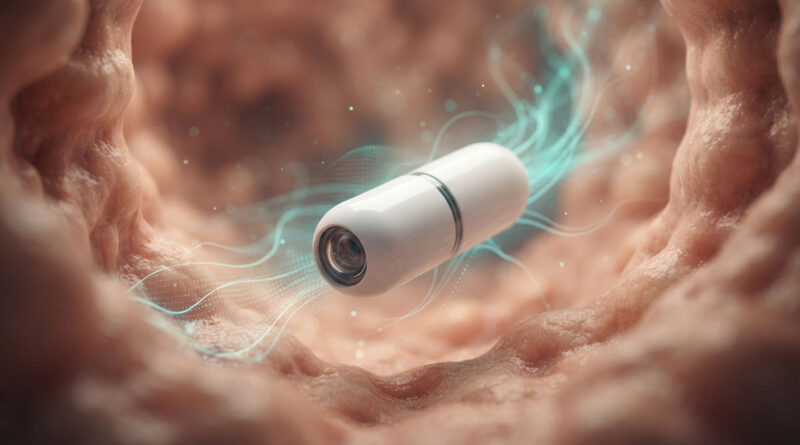
Wireless Capsule Endoscopy (VCE) has become a standard diagnostic procedure over the last two decades. This non-invasive examination allows physicians to evaluate the mucosa of the small intestine and, in more recent applications, other sections of the gastrointestinal tract. The patient swallows a small capsule that travels through the digestive tract via peristalsis, capturing thousands of images.
Theoretically, this is an ideal solution. In practice, however, analyzing the video footage remains a challenge. The material may contain over 50,000 individual frames from the small intestine. Reviewing this recording is extremely time-consuming for a specialist and requires intense concentration to avoid overlooking subtle abnormalities. Analysis time typically ranges from 30 to 60 minutes, depending on the physician’s experience.
Artificial intelligence (AI) is entering this process as a powerful assistant rather than a replacement for the clinician. Deep learning algorithms are trained on vast datasets to recognize specific image features. The goal is the automated detection of pathological lesions, such as bleeding, vascular abnormalities (angiodysplasia), ulcers, polyps, or tumors. While this technology has the potential to significantly reduce review time and improve the detection of potential abnormalities, it still requires proper validation and specialist oversight.
Algorithms supporting the human eye in the analysis of thousands of images
The application of AI in capsule endoscopy is no longer merely a laboratory experiment. A systematic review published in 2025 analyzed AI-based solutions available in systems designed for clinical use. The results indicate that these systems achieve high efficacy in detecting certain types of lesions. Algorithms can be trained to recognize specific patterns—such as acute or chronic bleeding—enabling them to automatically flag suspicious frames.
Recent studies confirm this finding. A multicenter prospective study published in 2024 in The Lancet Digital Health compared standard video analysis with analysis assisted by an AI system. The study involved 137 patients with suspected small-bowel bleeding. The results were striking.
Regarding bleeding-related lesions, the diagnostic performance of AI-assisted analysis was non-inferior to standard review by an experienced physician. However, a key difference lay in the analysis time. The average review time was 33.7 minutes using the standard method, compared to just 3.8 minutes with AI-assisted analysis—representing nearly a tenfold increase in workflow speed.
This means the physician does not waste time reviewing healthy sections of the intestine; instead, the AI system automatically selects images requiring special attention. These selected frames are then evaluated by a human. Thus, the technology serves as a tool to support the specialist rather than acting as an autonomous diagnostician-a distinction crucial to understanding its current capabilities. Artificial intelligence can analyze a vast number of images much faster than a human, but this speed is not synonymous with full diagnostic accuracy; therefore, the final interpretation always rests with the physician.
Progress in clinical research on AI in capsule endoscopy
The scale of ongoing research demonstrates the rapid development of this field of medicine. A systematic review and meta-analysis published in the journal Diagnostics in April 2026 covered a total of 72 studies on AI in wireless capsule endoscopy. Researchers analyzed AI applications for detecting, classifying, segmenting, and localizing abnormalities within the gastrointestinal tract.
The authors of the review highlighted the high overall diagnostic efficacy of the methods studied. The best results were observed in the detection of bleeding and vascular lesions. Results for other categories—including inflammatory bowel diseases (such as Crohn’s disease) and polyps—were more varied, indicating that the algorithms still require refinement to better identify more subtle inflammatory conditions.
At the same time, the meta-analysis drew attention to fundamental issues that must be addressed before AI can be widely and routinely used in clinical practice. These include, among others, insufficient external validation of algorithms, relatively small patient cohorts in some analyses, the retrospective nature of many studies, and significant differences in how results are reported and evaluated. Standardization is essential to enable direct comparisons of the efficacy of different platforms and algorithms—a task that is currently difficult to achieve.
Another important aspect is that while AI systems can significantly reduce analysis time, some lesions may still go undetected. Therefore, AI cannot currently be regarded as a complete substitute for assessment by a specialist. This is the key element for understanding the technology’s capabilities: artificial intelligence is intended to help detect potentially abnormal changes and significantly reduce the time required to review the footage, but it does not absolve the physician of responsibility.
Technological limitations and challenges in daily clinical practice
A key question for practitioners remains: will camera capsules and artificial intelligence replace traditional endoscopy? The answer requires caution. Capsule endoscopy has specific applications and limitations. For small bowel assessment, it is an extremely important—and often primary—diagnostic tool, recommended by the European Society of Gastrointestinal Endoscopy (ESGE) for indications such as suspected small bowel bleeding.
However, the capsule is not a simple substitute for every endoscopic procedure. Unlike conventional gastroscopy or colonoscopy, the capsule is primarily used for imaging and recording. It does not allow the physician to collect a tissue sample (biopsy) for histopathological examination or perform a therapeutic procedure (such as polyp removal or hemorrhage control) during the examination in the same way.
Therefore, the development of AI should currently be viewed primarily as an enhancement of the analysis of data obtained via the capsule, rather than a straightforward path to completely replacing all traditional endoscopic examinations. The camera capsule is no longer merely a technological novelty; rather, its integration with AI is emerging as a major trend in the evolution of gastrointestinal diagnostics.
The most critical question facing researchers is: can an algorithm be fully trusted? Technology is becoming increasingly advanced, yet this progress raises questions regarding safety and liability. If an algorithm fails to detect an abnormality—and the physician subsequently overlooks it as well—the consequences could be significant. For this reason, researchers emphasize not only the high sensitivity of AI systems but also the need to validate them using data from centers and populations other than those used to develop the algorithm. A promising result obtained in a single laboratory study should not automatically imply that identical effectiveness will be achieved in every hospital and with every patient. The stages of external validation and standardization still stand between promising laboratory results and widespread, safe clinical application.
References:
Sahafi A., Koulaouzidis A., Naemi A., Artificial Intelligence in Gastrointestinal Wireless Capsule Endoscopy: A Systematic Literature Review and Meta-Analysis, “Diagnostics”, 2026, 16(9), 1269.
Spada C. et al., AI-assisted capsule endoscopy reading in suspected small bowel bleeding: a multicenter prospective study, “The Lancet Digital Health”, 2024, 6, e345–e353.
Giordano A. et al., Integration of Artificial Intelligence-Enhanced Capsule Endoscopy in Clinical Practice: A Review of Market-Available Tools for Clinical Practice, Digestive Diseases and Sciences, 2025.
Dhali A. et al., Artificial Intelligence-Assisted Capsule Endoscopy Versus Conventional Capsule Endoscopy for Detection of Small Bowel Lesions: A Systematic Review and Meta-Analysis, “Journal of Gastroenterology and Hepatology”, 2025.
Soffer S. et al., Deep learning for wireless capsule endoscopy, “Gastrointestinal Endoscopy”, 2020.
European Society of Gastrointestinal Endoscopy (ESGE), guidelines for capsule endoscopy of the small intestine.