
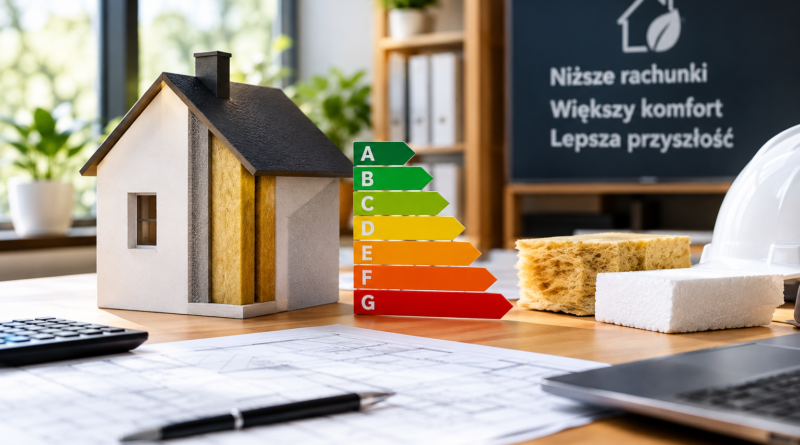
Energy Renovation of Buildings in 2026
New Regulations, Costs and Challenges for the Industry
Building Energy Renovation and the EPBD Directive
From Energy Audit to Design: How to Plan an Effective Thermal Retrofit
Materials, Installations and Quality Control: Where Do Costly Mistakes Occur?
Financing and Market Outlook: What Investors and Contractors Need to Know
New Regulations, Costs and Challenges for the Industry
Changes to EU regulations, new rules under the “Clean Air” programme, and the growing importance of workmanship quality are shaping the thermal renovation market in 2026. For property owners, this means a greater need for careful investment planning. Designers, building material manufacturers and contractors, in turn, must combine technical expertise with up-to-date knowledge of regulations and the rules governing the financing of renovation works.
At the centre of these changes is the Energy Performance of Buildings Directive, known as EPBD. It sets the direction for the gradual improvement of the energy efficiency of Europe’s building stock. However, this does not mean that every homeowner must immediately carry out a full thermal retrofit. In practice, the requirements depend on the type of property, the national legislation implementing the directive, and the conditions of specific support programmes.
Building Energy Renovation and the EPBD Directive
Directive (EU) 2024/1275 of the European Parliament and of the Council entered into force on 28 May 2024. Member States had until 29 May 2026 to transpose most of its provisions into their national legal systems. That deadline has passed, and on 15 July 2026, the European Commission announced that it had launched infringement proceedings against all 27 Member States for failing to fully transpose the directive. A separate, earlier deadline applied to provisions concerning the prohibition of financial incentives for the installation of fossil fuel boilers.
This is an important signal for the construction industry. Member States must continue working on the implementation of the regulations, while businesses should monitor both EU legislation and the measures being adopted in Poland. The directive itself establishes the framework and objectives, but specific obligations must be assessed in light of the relevant legislation and the type of building concerned.
The main objective of the EPBD is to improve the energy efficiency of buildings and gradually move towards a zero-emission building stock by 2050. The regulations cover, among other things, the renovation of existing buildings, requirements for new buildings, the use of solar energy, infrastructure for sustainable mobility, and solutions supporting the monitoring and control of technical building systems. However, not all these requirements apply to every building in the same way.
Residential Buildings: Energy Consumption Reduction Targets
For residential buildings, the directive establishes a national pathway for reducing average primary energy use. Member States must reduce it by at least 16% by 2030 and 20–22% by 2035, in accordance with the methodology set out in the legislation. At least 55% of the reduction must result from renovating the 43% of residential buildings with the poorest energy performance.
This does not mean that every home must achieve the same result. Member States can adapt their measures to national circumstances and choose solutions that help them meet the targets. Property owners should therefore check the requirements applicable to their own properties rather than assume that the directive imposes identical obligations on everyone.
Non-Residential Buildings: Minimum Energy Performance Standards
A different approach applies to non-residential buildings. The directive introduces Minimum Energy Performance Standards (MEPS), based on thresholds established at national level. The regulations aim to ensure that renovations cover 16% of non-residential buildings with the poorest energy performance by 2030 and 26% by 2033.
Owners of office buildings, warehouses, retail premises and other commercial properties should therefore check the requirements applicable to their particular type of building rather than assume that all properties are subject to identical thresholds.
New Buildings and Renovation Plans
From 1 January 2028, the zero-emission building standard is to apply to new buildings owned by public authorities, and from 1 January 2030, to all new buildings covered by the directive. The detailed obligations are set out in the directive and the national measures implementing it.
It is important to distinguish between the objectives of the regulations and the direct obligations imposed on property owners. The EPBD does not introduce a general ban on selling or renting buildings solely because of their poor energy performance. Nor does it require every existing home to undergo automatic, immediate renovation. The scope of the requirements depends on the type of property and the national legislation adopted.
Another key element of the changes is the development of national building renovation plans. Member States must submit their final versions by 31 December 2026. These documents should describe the current building stock, targets for the coming years, and planned measures and investment needs. For businesses, they will provide insight into the direction of renovation policy, although they do not, in themselves, guarantee a specific number of contracts or a particular level of future demand.
From Energy Audit to Design: How to Plan an Effective Thermal Retrofit
A successful renovation begins with an assessment of the building’s condition, not with choosing the most popular insulation material or heat source. Investors should identify where the building loses energy, which systems need improvement, and which measures will deliver the best results under the specific circumstances. This can be established through an on-site inspection, an analysis of energy consumption, an assessment of existing systems and, depending on the type of project, an energy audit.
An energy audit makes it possible to compare renovation options and define the scope of work. It can also help determine whether replacing the heat source is justified before energy losses have been reduced. In an older building, simply installing modern heating equipment may not solve the problem of high running costs. If the walls, roof, floor or windows have poor thermal performance, the property may still require a substantial amount of energy.
The scope and sequence of work should be based on the audit and the building’s technical condition. In many cases, it makes sense to reduce heat loss first and then select a heating system suited to the building’s revised energy demand. However, this is not a universal approach for every property. The right plan depends, among other factors, on the condition of the structure, existing systems, technical constraints and the investor’s budget.
The main areas to assess when planning a renovation include:
- Insulation of the building envelope – insulating walls, roofs or ceilings can reduce heat loss. The results depend on choosing suitable materials and ensuring high-quality installation.
- Windows and doors – even a product with excellent performance parameters will not deliver the expected results if the installation team fails to ensure proper fitting, airtight joints and the minimisation of thermal bridges.
- Ventilation – airtightening a building changes the conditions for air exchange. The design must therefore account both for reducing energy losses and for maintaining good indoor air quality.
- Heat source – heating equipment should be selected once the building’s energy demand has been established. A heat pump can be suitable for many buildings, but its efficiency depends, among other factors, on the heating system’s parameters, flow temperature and the building’s characteristics.
- Phasing the work – if an investor cannot finance the entire renovation at once, the sequence of works should be planned to avoid duplicated costs and complications at later stages.
For projects covered by the “Clean Air” programme, investors must also check the current funding conditions. The programme requires an energy audit and an energy performance certificate upon completion of the project. Investors should establish the required documentation, deadlines and settlement procedures in advance to avoid problems during the funding process.
Materials, Installations and Quality Control: Where Do Costly Mistakes Occur?
Energy efficiency depends not only on the properties of the materials used, but also on the quality of the design and workmanship. Choosing insulation with excellent thermal performance will not compensate for installation errors. Contractors should therefore ensure that products comply with the project specifications, that surfaces are properly prepared, that materials are securely fixed and that the entire system is airtight.
The most common areas of risk on construction sites include:
- Thermal bridges – these can occur around balconies, lintels, wall-to-floor junctions, and windows and doors. In these areas, heat may escape more rapidly than through the rest of the building envelope. Poorly designed or executed details increase energy losses and, under favourable conditions, can lead to moisture condensation and mould growth.
- Inadequate surface preparation and installation – omitting certain tasks, failing to execute details accurately or disregarding manufacturers’ instructions can result in complaints and costly repairs.
- Oversized heating equipment – a building’s heating demand may change after a thermal retrofit. If the designer fails to account for this change, the heat source may be incorrectly sized.
- Lack of coordination between trades – insulation, window replacement and building services work should be planned together rather than treated as independent tasks.
Quality control should not be limited to inspecting the finished façade. Depending on the scope of the project, it is worth documenting successive stages of the work, checking the materials used and inspecting critical areas before they are covered up. Thermal imaging surveys can also be useful, provided they are carried out under suitable conditions and the results are interpreted by a suitably qualified professional. Thermal imaging can help identify certain defects, but it does not replace design documentation, measurements or a professional technical assessment.
Heating system selection requires similar care. The key considerations include not only the unit’s capacity, but also system balancing, control configuration and correct commissioning. Ventilation must not be overlooked either. Reducing uncontrolled airflow through gaps and leaks does not mean that the necessary exchange of indoor air should be restricted.
For manufacturers and suppliers of building materials, this means ensuring consistently high product quality and providing reliable technical documentation. Contractors, in turn, can gain a competitive advantage through their expertise, punctuality and ability to coordinate different stages of work. In comprehensive renovation projects, cooperation between designers, energy auditors, heating engineers and installation teams is essential to achieving the intended results.
Financing and Market Outlook: What Investors and Contractors Need to Know
The cost of a comprehensive renovation can be substantial, which is why investors often combine their own funds with available forms of financial support. In Poland, one of the key instruments remains the “Clean Air” programme. Changes taking effect on 20 July 2026 are intended to make grants easier to access in certain circumstances, increase support for selected works and extend the time allowed to complete projects covered by advance payments. The new rules apply to applications submitted from that date onwards.
The main changes to the programme include:
- Exceptions to the three-year property ownership requirement – in certain specified circumstances, the programme allows a shorter ownership period, subject to detailed conditions.
- Higher unit cost limits – the maximum grant amounts for selected thermal renovation works have increased by 10%.
- More time to complete work covered by advance payments – the deadline for completing this scope of work has been extended from 120 to 180 days.
- More options for confirming completed work – the changes introduce measures to facilitate obtaining the required documentation.
However, these changes do not mean that every applicant will receive a higher grant for the entire project. Income eligibility criteria, eligible cost limits, documentation requirements and other programme conditions remain in force. The overall grant limits remain at up to PLN 33,200 under the basic level, PLN 58,100 under the increased level and PLN 83,000 under the highest level of funding. Before starting work, investors should check the current programme rules and ensure that their planned project qualifies for support.
The rules governing heat sources are also important. According to the programme information, a transitional period applies until the end of 2026 to electric heating systems other than heat pumps. From 2027, the programme will no longer support these types of heating, including electric heating mats, electric boilers and electric radiators. The withdrawal of subsidies should not, however, be confused with a ban on using a particular appliance. It concerns eligibility for financial support under the programme.
Another available instrument is the thermal modernisation tax relief. Eligible individuals can deduct qualifying expenditure up to a limit of PLN 53,000. The deduction is subject to specific conditions, and expenses financed or reimbursed through grants cannot be deducted again to the extent specified in the legislation. Before filing a tax return, taxpayers should check the current list of eligible materials, equipment and services, as well as the rules governing the combination of tax relief with other forms of support.
For construction and installation companies, the growth of energy renovation presents an opportunity to expand their services, but it also brings greater responsibility. Investors need more than teams capable of installing insulation. They also need specialists who can work with energy auditors, select solutions suited to individual buildings, plan project stages and prepare the necessary documentation. Companies should therefore develop their expertise, keep their knowledge of products and regulatory requirements up to date, and communicate potential results clearly to clients.
Businesses should also be cautious when forecasting demand. EU targets establish the long-term direction of change, but they do not determine the number of contracts in a particular region or the pace of market growth. Investment decisions are also influenced by household incomes, access to financing, energy prices, construction costs and broader economic conditions. Companies that combine technical expertise with transparent pricing, reliability and professional customer service may therefore be better positioned to build a stable market presence.
Building energy renovation in 2026 requires a broader perspective than simply replacing a heat source or insulating walls. European regulations establish the long-term direction, national programmes define the conditions for financial support, and the quality of design and workmanship determines the practical results of an investment. For property owners, this means planning carefully and making informed decisions. For designers, manufacturers and contractors, it means continually developing their expertise and working together.
References
- European Parliament and Council of the European Union, Directive (EU) 2024/1275 on the energy performance of buildings (recast), consolidated version: EUR-Lex – Directive text. <Cite refs={[“turn606309search0”]}/>
- European Commission, The Commission Calls on EU Countries to Transpose the Reinforced Rules on the Energy Performance of Buildings, 15 July 2026: European Commission – announcement.
- European Commission, Energy Performance of Buildings Directive: European Commission – EPBD information.
- National Fund for Environmental Protection and Water Management (NFOŚiGW), Changes to the Clean Air Programme: Easier Access to Grants from 20 July, 13 July 2026: Official announcement. <Cite refs={[“turn606309search1”]}/>
- Ministry of Climate and Environment of Poland, Higher Funding and Simpler Rules – Changes to the Clean Air Programme Have Come into Force, 20 July 2026: Official announcement. <Cite refs={[“turn606309search2”]}/>
- Ministry of Finance of Poland, Thermal Modernisation Tax Relief: Who Can Claim It and How Much Can Be Deducted: Tax Portal – thermal modernisation tax relief.