Generating electricity from moisture in the air
Generating Electricity from Moisture in the Air – A New Direction in the Development of Renewable Energy
How Does This Technology Work?
Why Does Moisture in the Air Have Energy Potential?
Field Tests and Effectiveness Confirmation
Applications in Low-Power Electronics and IoT
Importance for Regions Without Access to Energy
Technological Limitations and Challenges
Development Prospects and Role in the Energy Transition
Gaining electricity from moisture in the air – a new direction in the development of renewable energy
Generating electricity from moisture in the air is increasingly featured in discussions about the future of renewable energy sources. Until recently, this solution operated primarily as a laboratory concept. Today, however, real-world prototypes and field tests demonstrate that atmospheric moisture can become a stable and clean source of electricity. Scientists suggest that this technology can complement existing renewable energy systems, especially where other solutions fail.
An innovative device developed by researchers at Kyoto University (Japan) uses a special nanocoating that absorbs water vapor from the air and converts it into a direct current. A key advantage of this solution is its independence from sunlight, wind, and grid infrastructure.
How does this technology work?
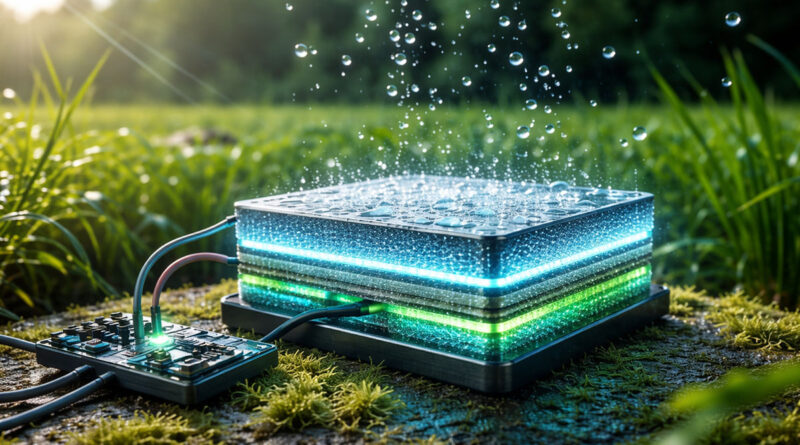
The generator’s operating principle is a layered nanocoating with a precisely designed structure. This material absorbs water molecules present in the atmosphere. Their movement and differences in humidity concentrations create an electrical charge gradient. This process generates a stable flow of electrons, i.e., direct current.
The device has no moving parts. It requires no external power supply or periodic maintenance. It can operate continuously 24 hours a day, even at night and under cloudy skies. This is a fundamental difference compared to photovoltaic panels or wind turbines.
Why moisture in the air has energy potential
Atmospheric humidity is present almost everywhere. Even in arid regions, the air contains some water vapor. In temperate and tropical zones, humidity remains stable throughout most of the year.
To date, renewable energy has rarely utilized this resource, focusing primarily on solar, wind, and hydropower. Generating electricity from airborne moisture introduces a new category of energy sources based on nanoscale physical phenomena.
Importantly, the device can operate both outdoors and indoors. Moisture generated by natural processes such as ventilation, respiration, and industrial production can also power the system.
Field tests and confirmation of effectiveness
The technology was tested in real-world environmental conditions. According to TrendPulse, generators installed in rural areas of Southeast Asia powered sensors and data transmitters for months without interruption.
Tests were conducted, among other places, in rice fields, where high humidity naturally occurs. The devices demonstrated high operational stability and resistance to changing weather conditions. The absence of mechanical components significantly reduced the risk of failure.
The generator’s small size facilitated installation in locations remote from power infrastructure, confirming the technology’s potential for distributed applications.
Applications in low-power electronics and IoT
The technology’s greatest potential lies in the area of energy-efficient electronics. Generators can power environmental sensors, monitoring systems, Internet of Things devices, and data transmitters.
In such applications, continuous power, not high power, is crucial. Generating electricity from moisture in the air allows for the creation of autonomous systems that operate for years without battery replacement. This lowers operating costs and reduces the amount of electrical waste.
The technology can also support smart agriculture, climate monitoring, and early warning systems.
Importance for regions without access to energy
In many parts of the world, the lack of access to stable electricity remains a serious problem. Building traditional infrastructure can be costly and time-consuming. Generators that utilize air humidity can operate independently of the power grid.
Such solutions can power medical devices, communication systems, and local sensor networks. This improves the safety and quality of life of residents in remote regions. At the same time, they do not emit pollutants or impact the natural environment.
Technological Limitations and Challenges
Despite promising results, the technology remains in its early stages of development. The greatest challenge is the scale of energy production. Currently, generators produce only a small amount of power, sufficient mainly to power low-power devices.
The system’s efficiency also depends on air humidity levels. In very dry conditions, efficiency can decrease. However, scientists are working on new materials that will increase the effective range of operation.
The history of photovoltaics demonstrates that such limitations can be overcome with technological advancements and scaled production.
Development prospects and role in energy transformation
Generating electricity from air humidity won’t replace traditional renewable energy sources. However, it can significantly complement them, especially in distributed, autonomous systems, and in remote locations.
This technology increases the resilience of energy systems and supports the decentralization of energy production. In the long term, it could play a significant role in the global energy transformation.
Generating electricity from air humidity is a viable and proven area of research. The nano-coating-based generator operates continuously, without sunlight or fossil fuels. It is durable, compact, and virtually maintenance-free.
Although currently used primarily in low-power electronics, its potential is steadily growing. This is an example of an innovation that doesn’t promise an overnight revolution, but consistently pushes the boundaries of modern energy.
References
Geeks Around Globe, Electricity generation from atmospheric humidity – emerging technologies, 2024.
TrendPulse, Humidity-based power generators tested in real-world conditions, 2024.
University of Kyoto, Department of Materials Science, publications on nanocoatings and energy conversion from atmospheric humidity.
AIST – National Institute of Advanced Industrial Science and Technology (Japan), Hygroelectric cell research reports, 2022–2024.
KopalniaWiedzy.pl, Air-gen and technologies for extracting energy from air humidity, popular science articles.