Physical AI in Industry: How Are Robots Learning in Factories?
Robots Are Starting to Learn. Physical AI Enters Industry
Five Million Robots and the Next Stage of Automation
A Robot Can Learn on Site
The Factory Must Learn to Trust AI
Humans and Robots Working on the Same Process
Robots Are Starting to Learn. Is Physical AI Entering Industry?
Just a few years ago, an industrial robot was primarily associated with a machine performing a programmed sequence of movements. Repeatability was its greatest advantage. If the product, workstation and working conditions remained the same, the robot could perform the same operation thousands of times.
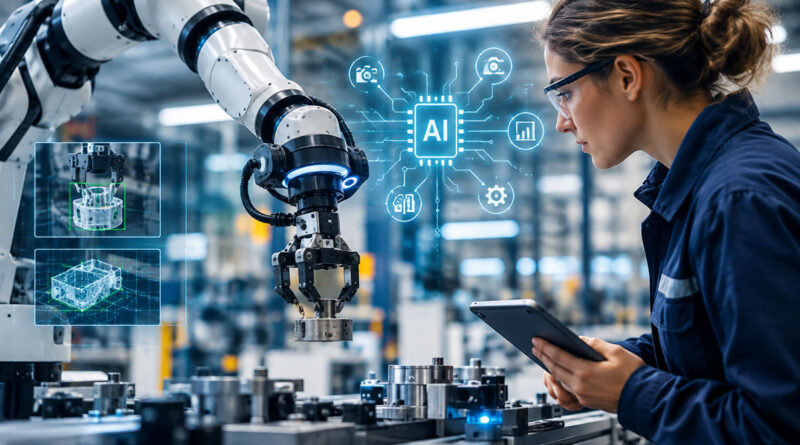
Now, another layer of technology is entering robotics. Physical AI, meaning artificial intelligence operating in the physical world, is intended to help machines better recognize their surroundings, interpret data from sensors and adapt their actions to changing conditions.
This is no longer just a research concept. Research institutions are working on such solutions, while technology companies are demonstrating concrete applications in manufacturing, logistics and infrastructure maintenance.
Five Million Robots and the Next Stage of Automation
The scale of change in robotics is enormous. According to the latest report from the International Federation of Robotics, around five million industrial robots were operating worldwide at the end of 2025. In 2025 alone, factories installed more than 600,000 new units, while the number of operational robots increased by 9 percent.
This is an important moment for industry because the development of artificial intelligence is already taking place on existing robotic infrastructure. A robot does not have to start from scratch. It already has motors, arms, cameras and sensors. What is new is the AI layer, which makes it possible to use these capabilities more effectively.
The International Federation of Robotics identifies AI and autonomy as one of the key directions in robotics development in 2026. The organization points, among other things, to the use of AI for data analysis, failure prediction, motion planning and increasing machine autonomy.
In conventional automation, humans define the rules governing how a machine operates, while the robot executes a prepared program. Physical AI takes this a step further. The system can receive information from the physical world – including data from cameras and sensors – and then use AI models to interpret the situation and adapt its actions.
In practice, this can mean a greater ability to handle situations that were not precisely described in the program beforehand. This is particularly important in short-run production, when there are many product variants, and wherever components are flexible, delicate or not always positioned in exactly the same place.
A Robot Can Learn on Site
One specific example is a solution presented by Hitachi in March 2026. The company developed a Physical AI technology that allows a robot to learn from data collected directly at the place where the work is performed and gradually optimize its own movements. The system uses, among other things, information from cameras as well as vision and force sensors.
According to Hitachi, the technology can be used in manufacturing, equipment maintenance and logistics. One example is the assembly of wire harnesses, a task that requires careful handling of flexible materials.
The company also states that the AI model it developed can issue commands at a frequency of up to 100 times per second. This is intended to enable a rapid response to information from sensors and allow the robot to perform more complex movements.
This illustrates the difference between traditional automation and a new generation of robotic systems. The goal is not simply to make a robot perform a movement faster. It is to ensure that the robot can appropriately change its movement when the situation changes.
This is precisely where one of the biggest challenges of traditional robotics lies. It is relatively easy to automate a task that looks exactly the same every time. It is much more difficult to create a machine that can handle a product positioned slightly differently from the previous one, a soft component, changing process parameters or an unexpected situation.
The Factory Must Learn to Trust AI
The development of Physical AI does not end with creating the right model. A factory environment is much more challenging than a controlled laboratory. A robot must work alongside other machines, respond to changes, perform tasks for many hours and maintain an appropriate level of safety.
The National Institute of Standards and Technology is running a project focused on Physical AI and data generation for robotics. Among other things, its goal is to develop methods for testing and measuring the performance of AI-powered robots in real-world manufacturing applications.
This is important because an AI-powered robot must not only be effective. It should also be predictable, sufficiently fast, safe and verifiable.
The International Federation of Robotics also highlights the integration of information technology with operational technology, or IT and OT. This allows data from IT systems to be used to control processes taking place in the physical world.
A robot can therefore receive information not only from its own sensors. It can be part of a larger system in which data on production, quality, orders or machine condition influences how subsequent tasks are performed.
Physical AI is often associated with humanoid robots. In industry, however, solutions based on conventional robotic arms, mobile robots and cobots are also being developed. The future does not necessarily have to mean factories filled with humanoids. A more likely scenario is the development of various types of robots equipped with increasingly advanced artificial intelligence.
Humans and Robots Working on the Same Process
The development of Physical AI does not automatically mean the elimination of jobs. Robotics can take over repetitive tasks, tasks requiring a high degree of precision, or those performed in conditions that are difficult for humans. At the same time, skills related to operating, programming, maintaining and supervising automated systems are becoming increasingly important.
The IFR identifies labor shortages as one of the factors driving the development of robotics. According to the organization, automation can help companies address staffing shortages by taking over some routine tasks.
The biggest change, therefore, may not be that a machine replaces a human. In many facilities, it will be about something else: a human will work alongside a machine that is capable of doing more than before.
The scale of this change could be significant. According to the IFR, the global number of robot installations is expected to continue growing. The organization forecasts around 655,000 new installations in 2026 and approximately 806,000 in 2029.
If robots are also given increasingly advanced AI capabilities, industry may move from automation based primarily on repeating instructions toward automation that adapts more effectively to the real world.
There are already millions of robots. The next stage may be about enabling them to better understand what is happening around them.
Bibliography
- International Federation of Robotics (IFR), Five Million Robots now Operate in Factories Globally. World Robotics 2026 Report released, September 24, 2026.
- International Federation of Robotics (IFR), Top 5 Global Robotics Trends 2026, January 8, 2026.
- International Federation of Robotics (IFR), AI in Robotics – New Position Paper, February 10, 2026.
- Hitachi, Ltd., Hitachi develops Physical AI technology that learns and optimizes its own motion behavior on-site to automate complex tasks, March 23, 2026.
- National Institute of Standards and Technology (NIST), Physical AI and Data Generation for Robotics, updated April 24, 2026.
- National Institute of Standards and Technology (NIST), Measurement Science for Robotics and Autonomous Systems Program.