
MES Systems in Manufacturing – How Does Manufacturing Management Software Increase Plant Efficiency?
MES Systems in Manufacturing – What Are They and What Role Do They Play in Modern Factories?
Key Functions of MES Systems – From Machine Monitoring to Quality Control
Integrating MES with ERP, SCADA and Industrial Automation
MES System Implementation – Benefits, Costs and Key Challenges
MES Systems in Manufacturing – What Are They and What Role Do They Play in Modern Factories?
MES systems in manufacturing (Manufacturing Execution Systems) are an important part of the digital transformation of modern industrial facilities. This class of software supports the management of production processes at the operational level. It collects information on order progress, monitors machine utilisation, controls material flows and enables the analysis of efficiency at individual manufacturing stages. As a result, businesses gain a more accurate picture of what is happening on the production floor and can respond more quickly to emerging disruptions.
In traditional management models, some information only reaches the relevant systems after a shift has ended or once documentation has been manually entered. Management therefore often analyses historical data that no longer reflects the current state of production. Meanwhile, an unplanned machine stoppage, a shortage of components or a recurring process error can affect order fulfilment times. An MES system reduces delays in information flow. It brings together data from different workstations and allows them to be analysed in the context of specific orders, machines and products.
However, MES is not simply a production recording tool. Its purpose is to support the execution of processes as they take place. Depending on its configuration, the system can provide operators with electronic instructions, record completed operations, monitor raw material consumption and flag deviations from established parameters. It can also help identify the causes of downtime and analyse production performance. The scope of functionality depends on the specific solution, its integration with other systems and the company’s requirements.
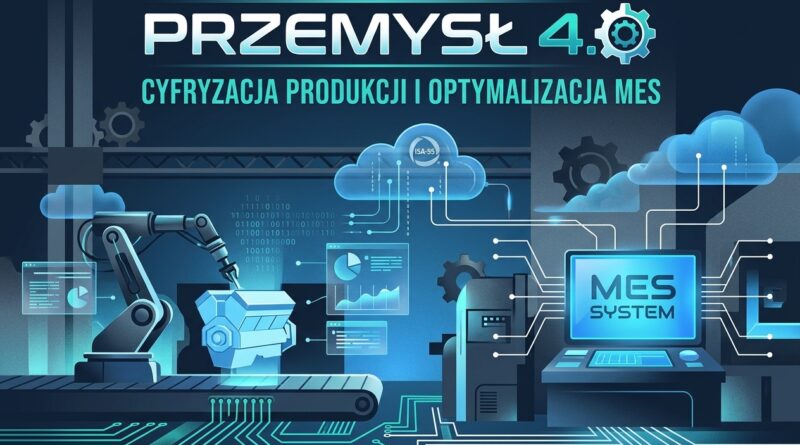
The position of MES systems within a factory’s IT architecture is well explained by the ISA-95 standard, developed by the International Society of Automation. It defines the relationships between business systems and solutions used directly in the production environment. In this model, Level 3 covers manufacturing operations management (MOM), including MES systems and SCADA solutions. Level 4 is responsible for enterprise planning and logistics, including functions performed by ERP systems. Lower levels cover process and equipment control, including the operation of PLCs and industrial sensors.
This division makes it easier to distinguish the responsibilities of individual solutions. ERP primarily handles resource planning, orders, purchasing, warehouse management and enterprise accounting. MES focuses on executing the production plan within the facility. SCADA supports the supervision of technological processes, while PLCs perform programmed machine control functions. These systems do not have to compete with one another. Their cooperation makes it possible to create a consistent flow of information between enterprise management and the day-to-day operations of the production facility.
The importance of MES systems also depends on the type of manufacturing involved. In discrete manufacturing, which includes equipment assembly, metalworking and the automotive industry, the software can track individual items, components and operations performed at successive workstations. In process manufacturing, typical of the food, chemical and pharmaceutical industries, greater importance is attached to recipes, process parameters, batches of raw materials and monitoring the entire production process. For this reason, the choice of system should take into account the specific nature of manufacturing rather than simply the size of the company.
Key Functions of MES Systems – From Machine Monitoring to Quality Control
The functional scope of MES systems covers several interconnected areas. However, not every company needs to use all the available modules. The selection should depend on the type of manufacturing, level of automation, work organisation and the problems the business aims to solve.
One of the core functions is monitoring the execution of production orders. The system records the start and completion of individual operations, as well as the number of finished products and defects generated. It makes it possible to compare actual production progress with the schedule and identify delays. This enables production managers to determine which orders require intervention, where bottlenecks occur and whether available resources are sufficient to complete planned tasks.
Another area is machine performance monitoring. An MES system can collect information from PLCs, SCADA systems and other data sources available within the facility. Depending on the integration in place, it records operating time, downtime, the number of completed cycles and selected process parameters, such as temperature or pressure. This makes it possible to determine when equipment is operating as intended and when disruptions affecting productivity occur.
The Overall Equipment Effectiveness (OEE) indicator plays an important role in analysing machine utilisation. It takes into account three elements: equipment availability, performance and the quality of manufactured products. Availability shows how long a machine operated in relation to the planned production time. Performance compares its actual operating speed with the target rate. Quality, in turn, measures the proportion of products meeting requirements in relation to total production output.
OEE provides a broader perspective on machine efficiency than operating time alone. High availability does not necessarily guarantee a good result if equipment operates below its target speed or produces a large number of defective items. An MES system can collect the data required to calculate this indicator and present the results in reports. It also facilitates the analysis of the causes of losses, such as breakdowns, minor stoppages, reduced operating speeds and production defects.
Depending on the scope of integration, the system can also provide data used to analyse maintenance performance indicators. These include MTBF (Mean Time Between Failures), which represents the average time between equipment failures, and MTTR (Mean Time To Repair), which measures the average repair time. These indicators help assess equipment reliability and the effectiveness of maintenance activities. However, calculating them accurately requires appropriate recording of incidents, operating time and repair information.
Work-in-progress material management is another important area of MES functionality. The system can record raw material withdrawals, their consumption in specific production orders and the movement of semi-finished products between workstations. This makes it easier to compare actual material usage with technological standards. Once integrated with a warehouse management system, it can also provide information on component availability and flag potential shortages. As a result, businesses can respond earlier to issues that could disrupt production continuity.
Quality control is also of great importance. An MES system can record measurement results, assign them to specific batches and process stages, and verify whether operators have completed the required inspection procedures. If a measurement exceeds established tolerance limits, a properly configured system can display a warning, initiate a non-conformance procedure or prevent a product from moving on to the next production stage. Such solutions reduce the risk of defective products undergoing further processing.
Another key function is production traceability. This involves linking a finished product to information about the raw materials used, batch numbers, process parameters, equipment and operations performed. In the event of a customer complaint or detected non-conformity, a company can more quickly determine which products are affected. This is particularly important in the food, pharmaceutical and automotive industries, as well as in medical device manufacturing, where documenting product history and process execution plays a significant role.
MES systems also support electronic document management. They can provide operators with up-to-date work instructions, technical drawings, recipes and checklists directly on workstation terminals. This reduces the risk of employees using outdated paper documents. The system can also record who performed a particular operation or approved an inspection result, and when this took place.
More advanced solutions may include functions related to personnel qualification management, tooling and equipment maintenance. For example, the software can verify whether an employee holds the required qualifications to perform a specific task. It can also collect information on tool usage and the number of equipment operating cycles. However, this does not mean that every MES system includes full maintenance management functionality or replaces specialised CMMS software. The scope of these capabilities depends on the vendor and the selected configuration.
Integrating MES with ERP, SCADA and Industrial Automation
An MES system delivers the greatest value when it exchanges data with other solutions used within an enterprise. Collecting information independently on the production floor improves process visibility, but it does not ensure full consistency if the data remains isolated from planning, warehouse management or control systems.
Integration between MES and ERP is particularly important. An ERP system provides information about customer orders, production plans, product bills of materials (BOMs), raw material availability and delivery deadlines. MES uses this data to organise work at the operational level. It then sends feedback on completed quantities, material consumption, processing times and any deviations from the plan.
For example, a company receives an order for a specific batch of components. The ERP system takes it into account during planning and prepares a production order. MES provides the information required to start work, assigns tasks to workstations according to the established production organisation and records operational progress. Once individual stages have been completed, it sends data on the quantities produced and materials consumed. This allows the planning and logistics departments to work with more up-to-date information, while production order settlement no longer has to rely solely on manually prepared reports.
It is also worth distinguishing production execution management from advanced scheduling. An MES system can support task allocation and execution at individual workstations. However, detailed planning that takes into account multiple technological constraints, resource availability and the optimal sequence of operations may require an additional APS (Advanced Planning and Scheduling) system. The scope of these functions depends on the company’s IT architecture.
Another important area is the integration of MES with SCADA (Supervisory Control and Data Acquisition) systems. SCADA software is primarily used to supervise technological processes, visualise equipment data and support operators in monitoring industrial installations. MES uses selected information to manage production workflows and analyse performance. For example, a signal indicating a drive failure can be linked to a specific production order. This makes it possible to determine more precisely when downtime occurred and how it affected the production schedule.
PLCs and industrial sensors also play an important role. Sensors measure process parameters and send signals to control systems. PLCs process this information and execute programmed machine functions. Depending on the plant’s architecture, an MES system can collect data from these devices on machine status, the number of units produced, cycle times or active alarms. However, it does not automatically take over machine motion control or responsibility for implementing safety functions. These tasks belong to appropriately designed automation and safety systems.
Communication standards and data models facilitate the integration of different solutions. ISA-95 organises terminology, information structures and relationships between manufacturing management systems and business applications. OPC UA, developed by the OPC Foundation, provides an architecture for exchanging data between industrial devices, controllers and applications. The organisation also provides an ISA-95 information model for OPC UA, which facilitates the representation of standard concepts and structures in communication between systems. These solutions therefore serve complementary purposes: ISA-95 helps define which information should be linked, while OPC UA provides the mechanisms for exchanging it.
However, integration requires proper preparation. A company should determine which systems will serve as the source of specific data, how frequently information should be updated and what should happen if communication is lost. The quality of master data is equally important, including material codes, technological routings, units of measurement and machine identifiers. Inconsistent data can lead to inaccurate reports, even when the software itself is functioning correctly.
Industrial cybersecurity is a separate but equally important consideration. Connecting IT systems with production infrastructure increases the number of potential points that need protection. Therefore, an integration project should take into account IT and OT network segmentation, access control, secure communication, software updates and incident response procedures. The US National Institute of Standards and Technology (NIST) emphasises that OT security measures must also account for the reliability, performance and safety requirements of physical processes.
MES System Implementation – Benefits, Costs and Key Challenges
Implementing an MES system can improve production process transparency, streamline quality control and reduce the time required to prepare reports. However, this does not mean that every company will achieve the same results. The outcomes depend on selecting the right functionality, data quality, the level of integration with existing infrastructure and how employees use the system.
One of the main benefits is faster access to production information. Managers can analyse order progress, the causes of downtime and machine utilisation without having to wait for reports prepared at the end of a shift. This makes it possible to identify deviations from the production plan earlier and take action to minimise their impact. In practice, the system provides information that supports decisions concerning work organisation, material availability and resource utilisation.
Another benefit is improved product traceability. Linking products to raw material batches, process parameters and operational histories makes it easier to investigate complaints and implement corrective actions. In companies operating in regulated industrial sectors, digital records can also streamline the preparation of documentation for audits and quality inspections.
MES can help reduce material and production losses. Data analysis makes it possible to identify recurring causes of defects, excessive raw material consumption, prolonged changeovers and unplanned downtime. For example, a company may discover that a particular machine regularly generates losses when starting a new production run. Process engineers can then analyse the technological parameters and plan improvements, using methods such as SMED. In this case, the MES system provides data for analysis but does not replace organisational and technical improvement activities.
At the same time, a company must take implementation costs into account. These include not only licence fees or subscription charges for cloud-based solutions. Integration with ERP and automation systems, network infrastructure, industrial terminals, barcode readers, software configuration and employee training are also important cost factors. Facilities operating older machinery may need to equip their machines with additional sensors or communication modules to enable automatic data collection.
For this reason, it is worth conducting a pre-implementation analysis before choosing a vendor. A company should identify the problems it wants to solve and determine which processes require the greatest level of control. Are unplanned stoppages the main challenge? Or perhaps a lack of traceability, reporting difficulties, excessive defect rates or inconsistent data on material consumption? Clearly defined objectives make it easier to select system functions that address actual business needs. They also help prevent companies from purchasing an extensive solution whose capabilities will largely remain unused.
A phased implementation is often a good approach for many businesses. Instead of introducing the system throughout the entire facility from day one, a company can start with a single production line or a selected area. A pilot project makes it possible to verify data accuracy, test integrations and assess whether the solution meets the needs of operators and management. Once any issues have been resolved and the initial assumptions confirmed, the company can gradually extend the implementation to other departments.
Employee preparation must not be overlooked either. Operators, process engineers, production planners and managers should understand what information the system collects and how the company uses it. If the software proves too complicated to operate and recording events requires numerous unnecessary tasks, employees may perceive MES as an additional administrative burden. This can reduce data quality and undermine the reliability of reports. That is why training, a user-friendly interface and taking into account the experience of people working directly on the production floor are so important.
When selecting a system, it is also worth checking its scalability, integration capabilities, configuration flexibility and the availability of technical support. The software should meet the facility’s current requirements while also allowing for future development as technological processes change. It is equally important to establish clear rules for updates, infrastructure maintenance and responsibility for data quality.
MES systems in manufacturing are not a universal solution to every problem faced by an industrial facility. They cannot replace well-designed processes, efficient work organisation or employee expertise. However, they provide up-to-date information that enables companies to monitor order execution more effectively, analyse losses and make decisions based on actual data. Combined with ERP, SCADA and industrial automation systems, they form an important part of a factory’s digital infrastructure. Their actual value depends not simply on implementing the software, but on how well it is tailored to the company’s needs, the quality of its integration and the consistent use of the information it collects.
References
- International Society of Automation (ISA), ISA-95 Series of Standards – Enterprise-Control System Integration. Official overview of the ISA-95 model, architecture levels and manufacturing operations management. https://www.isa.org/standards-and-publications/isa-standards/isa-95-standard
- SAP, What is a manufacturing execution system (MES)?, updated 26 January 2026. An overview of MES functionality and its role in enterprise IT architecture. https://www.sap.com/resources/what-is-mes
- OPC Foundation, OPC Unified Architecture – Common Object Model: ISA-95. Documentation on the ISA-95 information model and its use in OPC UA communication. https://reference.opcfoundation.org/specs/OPC-10030/full
- SAP Help Portal, OEE Calculations. Documentation on calculating the OEE indicator based on availability, performance and quality. https://help.sap.com/docs/sap-digital-manufacturing/insights/oee-calculations
- National Institute of Standards and Technology (NIST), Stouffer K. et al., Guide to Operational Technology (OT) Security, NIST Special Publication 800-82 Rev. 3, September 2023. Guidelines on securing OT infrastructure. https://doi.org/10.6028/NIST.SP.800-82r3