
The first wireless solar installation on railway tracks – a breakthrough in energy production
Pilot Project
Modern Technology on Railway Tracks
Potential and Benefits of Solar Track Installations
Challenges and Project History
The Future of Solar Track Installations
Pilot project
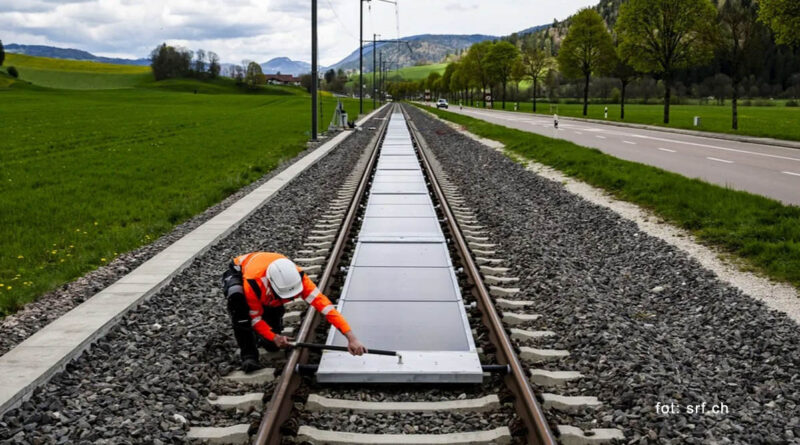
A solar installation on railway tracks is underway in Switzerland. This innovative project combines solar energy with rail infrastructure. Sun-Ways, a company from the canton of Vaud, installed photovoltaic panels on the tracks in the village of Buttes in the Val-de-Travers valley. This pilot project will be tested under real-world conditions for three years. This solution will allow previously unused space between the rails to be used for green energy production. This is an important step towards the sustainable development and realization of the potential of the Swiss railway network.
Modern technology on railway tracks
Sun-Ways has opted for modern technology. The company utilized a special Scheuchzer train for mechanical panel installation. This allows for the installation of up to 1,000 square meters of panels in just a few hours. This rapid installation translates into efficiency and time savings. The installation encompasses 100 meters of track, with 48 solar panels mounted. All electrical connections are contained within secure panel enclosures. Cylindrical brushes at the end of the train effectively remove dirt and grime.
Potential and benefits of solar installation on tracks
The Swiss railway network stretches several thousand kilometers, offering enormous potential for the development of track-based solar installations. Sun-Ways emphasizes that installing solar panels in such locations has not generated any opposition from the local community. Joseph Scuderi, founder and director of Sun-Ways, points out that trains operate primarily during the day, when the panels produce the most energy. The company plans not only to generate energy between the tracks but also to feed it back into the trains’ traction system. This will enable almost all of the energy produced to be used for rail purposes.
The Buttes project received support from the Federal Office of Transport (BAV), which approved it for a three-year period. The goal is to test how the installation will function under real-world conditions. This test period allows for monitoring the system’s efficiency and durability. The project is being implemented on the line of transN, a local rail operator in the canton of Neuchâtel. The installation covers a limited section, allowing for thorough monitoring and evaluation of the panels’ performance.
Challenges and project history
Initially, the project did not receive approval from the BAV. In 2023, Sun-Ways’ application was rejected due to an interim technical report that did not meet the authority’s requirements. Following this decision, the company announced it would implement “technical changes” and prepare a new permit application. This resulted in approval for the pilot project. This is an important step for the development of innovative energy solutions in transport infrastructure.
The future of solar installations on tracks
Joseph Scuderi hopes that the Buttes model will become a model for further installations worldwide. He estimates that in Switzerland alone, as many as 2.5 million panels could be installed along the entire length of the railway tracks. This scale of investment could significantly increase the share of renewable energy sources in the national energy mix. Integrating solar panels with the rail network is an example of an innovative approach to utilizing available space and resources.
The first solar installation on railway tracks in Switzerland is a groundbreaking project that opens up new possibilities for renewable energy production. Utilizing the space between the rails is an innovative idea that could be replicated globally. Thanks to quick installation, safety features, and a cleaning system, the panels have the potential to operate effectively for a long time. The Buttes project demonstrates that even in transport infrastructure, eco-friendly solutions can be implemented. In the coming years, this technology could revolutionize the way Switzerland and other countries generate energy. It is an example of the harmony between transport and ecology, which is becoming increasingly important in the era of global climate change.
source of the film: https://www.srf.ch/news/dialog/pilotprojekt-im-val-de-travers-erste-solaranlage-der-schweiz-auf-bahngleis-geht-in-betrieb