
Laser Weed Control – The Future of Chemical-Free Farming
Laser Weed Control Revolutionizes Agriculture
How the Laser Weed Control System Works
Carbon Robotics – the American Leader in Precision Weed Control
European Precision from Escarda Technologies
Laser-Electronics GmbH and Blue Laser Technology
WeedBot – a Latvian Innovation for Vegetable Crops
Benefits and Challenges of the New Technology
Opportunity for Polish agriculture
A future without herbicides
Laser weed control revolutionizes agriculture
Laser weed control is increasingly featured in conversations about modern, sustainable agriculture, and it’s not without reason that it’s generating such strong interest among farmers, scientists, and agricultural technology manufacturers. This solution, which seemed like a futuristic experiment just a few years ago, is now becoming a viable alternative to traditional weeding methods, both chemical and mechanical. Thanks to the combination of artificial intelligence, high-resolution cameras, and precise laser beams, it’s possible to remove unwanted plants without the use of herbicides and without disturbing the soil structure, opening a completely new chapter in crop protection.
How the Laser Weed Control System Works
The principle of laser weed control is based on extremely precise plant recognition and the laser system’s lightning-fast response. Equipped with a suite of cameras and sensors, the machine continuously scans the field surface, analyzing the image in real time. This process utilizes advanced deep learning algorithms that can distinguish between crops and weeds with pixel-perfect accuracy. When the system detects a weed, it directs a short, powerful laser beam at it, destroying the plant’s growth tissue, halting its further development. This is accomplished without contact with the soil and without the need for any chemicals, a significant advantage over traditional weed control.
Carbon Robotics – the American leader in precision weed control
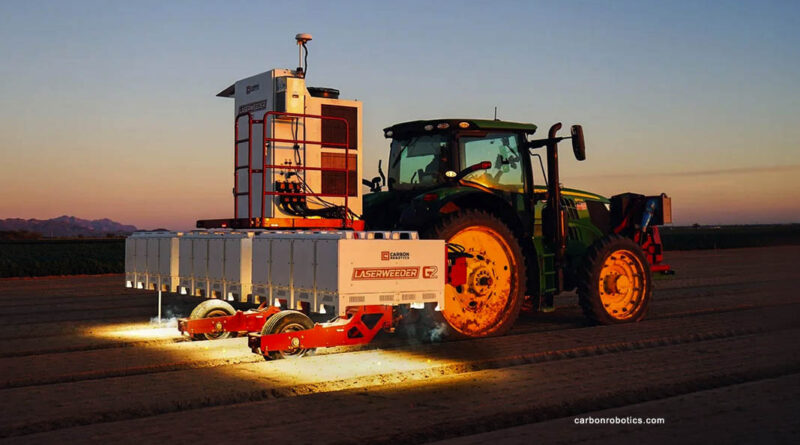
One of the pioneers of this technology is the American company Carbon Robotics, which has developed a machine called the LaserWeeder G2. This fully autonomous system, capable of 24/7 operation, utilizes a combination of high-resolution cameras, artificial intelligence, and as many as thirty 150-watt lasers. According to the manufacturer, the LaserWeeder can recognize over one hundred crop species and effectively eliminate up to 99% of weeds, leaving the soil intact and free of chemicals. Importantly, this technology not only increases weed control efficiency but also significantly reduces labor costs, as the robot operates autonomously, without the need for spraying or hiring additional workers.
European precision from Escarda Technologies
An equally interesting player in the laser weeding system market is the German company Escarda Technologies GmbH, which has developed its own system based on plant recognition and laser-assisted weed elimination. Production takes place in Germany, and the technology itself is being developed with European agriculture, including organic farms, in mind. Escarda focuses on compact and modular solutions that can be easily integrated with existing agricultural equipment. Thanks to local production and technical support in the European Union, the company is an attractive partner for farms looking to invest in modern, ecological weeding systems without having to import machinery from overseas.
Laser-Electronics GmbH and blue laser technology
Another example of an innovative approach is the German company Laser-Electronics GmbH, which has developed the BluEX Laser Weeding Tool module. Although the company does not manufacture complete agricultural machinery, its laser components can be a key element of modern weeding systems. The use of a blue diode laser with a wavelength of approximately 450 nm allows for highly accurate and energy-efficient operation. Such modules can be integrated with various agricultural robots, offering extensive possibilities for adapting the technology to the specific needs of a given crop.
WeedBot – Latvian innovation for vegetable crops
Laser weed control is also underway in Eastern Europe. Latvian company WeedBot is developing a prototype machine designed primarily for vegetable crops, utilizing an optical plant recognition system and a high-precision laser. Although the project is still in the development and commercialization phase, its design aligns with the growing demand for environmentally friendly solutions consistent with organic farming principles. WeedBot demonstrates that smaller, innovative companies from Central and Eastern Europe can also play an important role in transforming modern agriculture.
Benefits and challenges of new technology
Laser weed control offers farmers many benefits – primarily the complete elimination of the need for herbicides, which reduces chemical pressure on the environment and reduces the risk of groundwater contamination. Furthermore, the soil remains intact, and the root systems of crops are not damaged, promoting healthy growth. Another advantage is the possibility of fully automating the process – robots operate continuously and, thanks to artificial intelligence, learn to recognize a growing number of weed species.
On the other hand, this technology is not without challenges. The high cost of purchasing the machines is a barrier for many farms, especially smaller ones. It also requires appropriate operating conditions – the laser must provide a clear visual contrast between the plant and the soil, and in dry conditions, there is a risk of overheating or even fire. Therefore, manufacturers are constantly improving cooling systems, safety sensors, and image recognition algorithms to ensure maximum efficiency and reliability.
Benefits and challenges of new technology
In Poland, laser weed control technology may find applications primarily on organic farms, in vegetable and fruit crops, and in greenhouses in the coming years. For large grain and corn producers, investment costs and service availability will be key factors. However, as technology advances and laser component prices decline, these solutions can be expected to become more accessible to medium-sized farms. Combined with EU trends that increasingly restrict the use of chemical plant protection products, laser systems could become a cornerstone of modern, sustainable agriculture in Poland and Europe.
A herbicide-free future
Laser weed control is no longer a vision of the future, but a technology that is entering agricultural practice. Solutions like the LaserWeeder G2 from Carbon Robotics, systems from Escarda Technologies, modules from Laser-Electronics GmbH, and the upcoming WeedBot demonstrate that the agricultural world is moving toward precision, automation, and ecology. Although the initial costs are high, the long-term benefits—from cleaner soil, reduced fuel consumption, and the elimination of the need for herbicides—make it an investment in the future. Agriculture, which until recently relied primarily on chemistry and mechanics, is now entering the age of light, and the laser is becoming a tool that can transform the way we care for our crops and the environment.
Bibliography
Carbon Robotics – LaserWeeder G2. Automated Laser Weeding Technology.
https://carbonrobotics.com/laserweeder-g2;
Escarda Technologies GmbH – Laser Weed Control Systems. About Us.
https://www.escarda.tech/about-us;
Laser-Electronics GmbH – BluEX Laser Weeding Tool.
https://www.laser-electronics.de/en/products/bluex-laser-weeding-tool;
WeedBot – High Precision Laser Weeding Technology.
https://www.weedbot.eu;
Future Farming (2023) – Laser technology: the future of weed control in precision agriculture.
https://www.futurefarming.com/tech-in-focus/laser-technology-for-weed-control;
Agrarheute (2024) – Unkrautbekämpfung mit Laser – Chancen und Grenzen der neuen Technologie.
https://www.agrarheute.com/technik;
Scientific American (2022) – How laser-based robots could make farming greener.
https://www.scientificamerican.com/article/how-laser-based-robots-could-make-farming-greener.

