
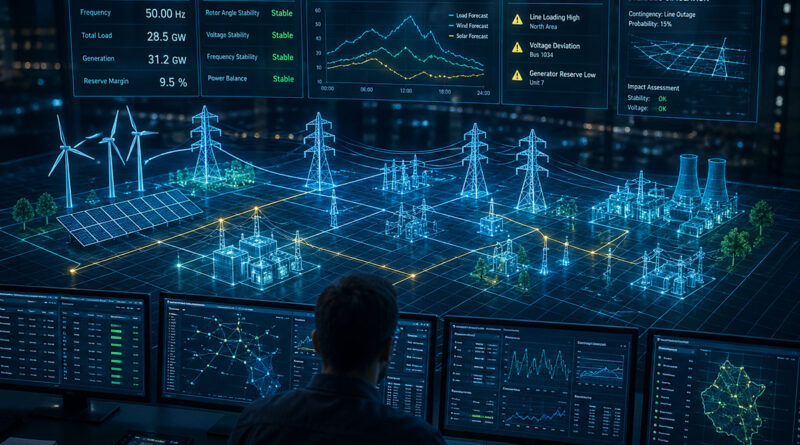
Digital twins in energy grid stabilization
Digital twins in power grid stabilization as a decision-making layer of modern power systems
Digital twin architecture and data integration in power systems
Applications of digital twins in grid stabilization and renewable energy integration
Practical implementations and directions of technology development
Challenges and the future of digital twins in the energy sector
Digital twins in power grid stabilization as a decision layer of modern power systems
Digital twins are no longer solely used for observational purposes in power grid stabilization. In modern power systems, they increasingly act as a decision-making layer, supporting transmission system operators in real time. Their role is shifting from grid state analysis to predictive control and active operational risk management.
The energy transformation based on renewable energy sources is changing the nature of power system operation. Traditional synchronous generation, which provides natural system inertia, is gradually being replaced by sources with variable and weather-dependent production. As a result, the system is becoming more dynamic and more difficult to stabilize in real time.
A digital twin maps the behavior of the power grid in a digital environment, integrating measurement data, physical models, and predictive algorithms. A key feature of this technology is the ability to simulate the effects of events before they actually occur. In practice, this translates into a shift from a reactive grid management model to a predictive and control model.
Digital twin architecture and data integration in energy systems
The architecture of digital twins in power systems is based on the integration of physical and digital infrastructure. The physical layer includes power plants, wind farms, photovoltaic installations, transmission lines, and transformer stations.
The data layer is responsible for continuously acquiring information from SCADA systems, PMUs, and smart meters. PMUs are particularly important, enabling synchronous, high-frequency measurement of network parameters and enabling near-real-time analysis of system dynamics.
The digital layer creates a multi-level model of the power grid, encompassing its topology, technical parameters, and operational dependencies. Models are continuously updated based on measurement data.
The analytical layer utilizes artificial intelligence algorithms, time series models, and graph neural networks, which represent the network structure as a complex system of interdependencies.
Edge computing architectures are increasingly being used, enabling data processing close to its source, reducing latency and increasing system resilience.
Applications of digital twins in grid stabilization and renewable energy integration
The most important application of digital twins in power grid stabilization is managing the variability of generation from renewable energy sources. These systems enable the prediction of short-term changes in generation and their impact on frequency and voltage stability.
Forecasting utilizes meteorological data and historical generation profiles. In optimization, digital twins enable dynamic management of power flows and testing of various grid operation scenarios.
In operational security, they enable the simulation of critical events such as loss of generation, transmission line failures, or sudden changes in system load.
In more advanced implementations, these systems support the automation of system responses, leading to partial autonomy in grid management.
Practical implementations and directions of technology development
One of the key applications of digital twins in the energy sector is systems developed by transmission network operators in Europe and North America. Organizations such as ENTSO-E and NREL use digital models to analyze system stability and renewable energy integration.
Case study – application of digital twins in ENTSO-E’s system stability analysis
Within European transmission systems, digital twins are used to simulate emergency scenarios, including cascading blackouts. The models allow for the simulation of grid disruption propagation and the analysis of the response of protection systems.
Such analyses examine the effects of the loss of large generation sources and the overloading of key infrastructure components. Digital twins enable testing of “what-if” operational strategies without impacting the actual system.
This allows operators to assess the effectiveness of preventive measures, such as redistributing power flows or activating system reserves.
A Key Paradigm Shift – From Observation to Real-Time Control
The most important development direction for digital twins in power systems is the transition from an analytical tool to an active element of system control.
In modern architectures, the digital twin operates in a closed-loop decision-making system. Data from the physical network is processed in real time, the model predicts the system’s state, and then generates operational recommendations or control signals.
This leads to the emergence of quasi-autonomous systems, in which network management is based on continuous analysis and prediction, rather than solely on event-based response.
Challenges and the future of digital twins in the energy sector
Despite their high technological maturity, digital twins still face challenges related to scalability, data quality, and cybersecurity.
Integrating massive amounts of data from SCADA and PMU systems requires advanced synchronization and validation mechanisms. Furthermore, protecting the digital infrastructure becomes crucial, as models represent critical elements of the energy system.
In the future, integrating digital twins with artificial intelligence systems and federated learning technologies will play a key role, enabling model training without data centralization.
In the long term, this technology could become the foundation of autonomous power grid management systems.
Bibliography
- Glaessgen, E., Stargel, D. (2012). The Digital Twin Paradigm for Future NASA and U.S. Air Force Vehicles. NASA Technical Reports;
- Tao, F., Qi, Q., Liu, A. (2019). Digital Twins and Cyber-Physical Systems toward Smart Manufacturing and Energy Systems. Engineering;
- International Energy Agency (IEA) (2023). Electricity Grids and Secure Energy Transitions;
- U.S. Department of Energy (DOE). Grid Modernization Initiative Reports;
- ENTSO-E. System Operation and Stability Analysis Reports;
- NREL. Renewable Integration and Grid Stability Studies;
- IEEE Power & Energy Society. Smart Grid and Digital Twin Applications;
- Kundur, P. (1994). Power System Stability and Control. McGraw-Hill;
- Siemens Energy. Digital Twin Applications in Power Systems;
- GE Grid Solutions. Digital Substation and Grid Modeling Technologies