Digital Twins – How Digital Twins Are Changing the Industry
Digital Twins – How Digital Twins Are Transforming Industries Before They’re Real
How Digital Twins Work and What Technologies Power It
The Secret Code in Our DNA Hidden in Viral Residues
The Secret Code in Our DNA Hidden in Viral Residues
Digital Twins - How Digital Twins Are Transforming Industries Before They're Real
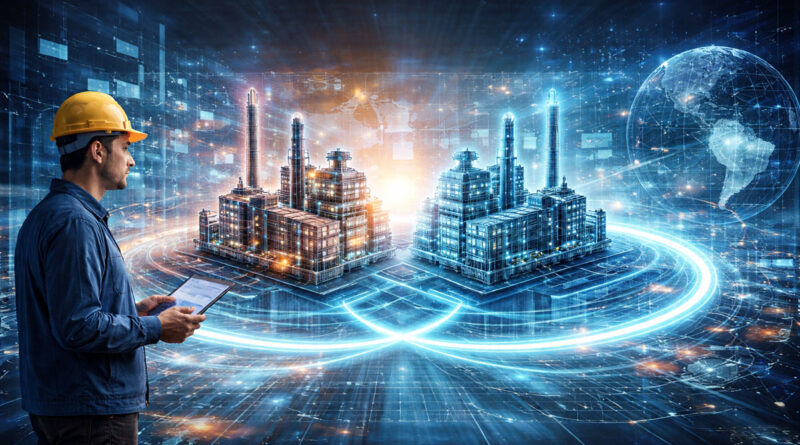
Digital twins, also known as digital twins, have ceased to be a futuristic concept over the past few years and have become a real tool for industrial transformation. Organizations are no longer limited to designing and testing solutions in the physical world. They are increasingly creating digital versions of products, machines, and entire operating systems to analyze their performance before implementation. Digital twins enable the simulation of scenarios, predicting the impact of decisions, and optimizing processes without the risk of costly errors. As a result, companies are changing their management approach, shifting from a reactive model to a predictive one, driven by data and analytics.
Digital twin technology allows for a dynamic representation of reality. The digital model is not merely a visualization, but a continuously updated system that integrates data from sensors, industrial systems, and analytical platforms. This allows the company to observe the behavior of an object in real time and predict its future state. From a management perspective, this represents a fundamental change. Decisions are no longer based solely on experience, but on tests conducted in a digital environment. In practice, the company “makes mistakes” in simulation, not in reality, which significantly reduces operating costs and investment risk.
How does a digital twin work and what technologies power it
Understanding how a digital twin works requires looking at the entire technological ecosystem that supports it. The foundation is the Internet of Things, which collects data from physical objects. Sensors monitor machine performance, energy consumption, temperature, and load. This data is then transferred to processing systems, where it is integrated and analyzed. Cloud platforms and edge computing solutions play a key role here, enabling rapid processing of information both centrally and close to the source.
The next element is ERP, MES, and SCADA systems, which provide operational context and allow for the linking of technical data with business processes. Only the integration of these layers enables the creation of a coherent digital model. Research by Tao and Zhang, published in IEEE Transactions on Industrial Informatics, indicates that data quality and the ability to process it in real time are key success factors. Without this, a digital twin loses its predictive value.
Mathematical modeling and computer simulations, which represent the behavior of systems under various conditions, also remain crucial components. With the development of artificial intelligence, these models gain the ability to learn from historical and current data. This allows the system to not only analyze the current state but also predict future events and identify potential anomalies. This element makes digital twins a predictive tool, not just an analytical one.
Digital twins in industry - from factories to cities
The use of digital twins in industry today encompasses almost every sector of the economy, but their greatest potential is revealed where processes are complex and the costs of errors are high. In the manufacturing industry, digital twin technology allows for the design and optimization of production lines before they are physically launched. Companies analyze various operating scenarios, identify bottlenecks, and test parameter changes, significantly shortening the time to implement new products.
A good example is Siemens, which uses digital twins to simulate the operation of factories and production processes. This allows the company to optimize production during the design phase, resulting in shorter line launch times and reduced costs. General Electric is using a similar approach in the energy sector, where digital turbine models allow for the prediction of failures and the planning of maintenance activities in advance.
In the energy sector, digital twins support the management of critical infrastructure, enabling the monitoring of power plants, transmission grids, and renewable energy installations. In construction, the technology is developing in conjunction with the BIM concept, where a digital building model functions throughout its entire lifecycle, supporting energy management and infrastructure maintenance. In logistics and transportation, digital twins enable the simulation of goods flows and the optimization of supply chains, which increases operational efficiency and reduces delays.
City digital twins are also gaining in importance. Singapore, for example, is developing the Virtual Singapore project, which enables traffic analysis, infrastructure planning, and urban environment management. Such solutions enable decision-making based on data and simulations, not just statistical forecasts.
Benefits, challenges and the future of digital twins
Digital twins offer businesses a range of benefits that directly impact their competitiveness. Primarily, they enable cost reduction by eliminating errors during simulation and improving process efficiency through better data utilization. The technology also supports predictive maintenance, which reduces downtime and increases system reliability. McKinsey reports indicate that implementing digital twins can significantly improve operational results, especially in areas with high process complexity.
At the same time, implementing digital twins presents significant challenges. Organizations face high upfront costs related to system integration and building a data infrastructure. Data quality is also crucial, as imprecise information leads to erroneous conclusions. Data security also remains a significant issue, especially in the context of critical infrastructure and industrial systems.
According to Gartner analyses, the development of digital twins will be closely linked to advances in artificial intelligence, data analytics, and communications technologies. In the coming years, digital models will become increasingly autonomous and capable of making real-time decisions. IBM emphasizes that the future of this technology lies in the full integration of the physical and digital worlds, where every important system has its digital counterpart. As a result, enterprises will make decisions based on simulation, not intuition. Digital twins are moving beyond innovation and becoming a standard in modern industry, defining how organizations design, manage, and develop their operations in the era of the data-driven economy.
Bibliography
- Smart Nation Singapore – Virtual Singapore
- IBM – What is a digital twin?
- McKinsey & Company – Digital twins: The foundation of the enterprise of the future
- Gartner – Digital Twin (IT Glossary)
- Tao, F., Zhang, H. (2019) – Digital Twin in Industry: State-of-the-Art, IEEE Transactions on Industrial Informatics.
- Fuller, A., Fan, Z., Day, C., Barlow, C. (2020) – Digital Twin: Enabling Technologies, Challenges and Open Research, IEEE Access.