
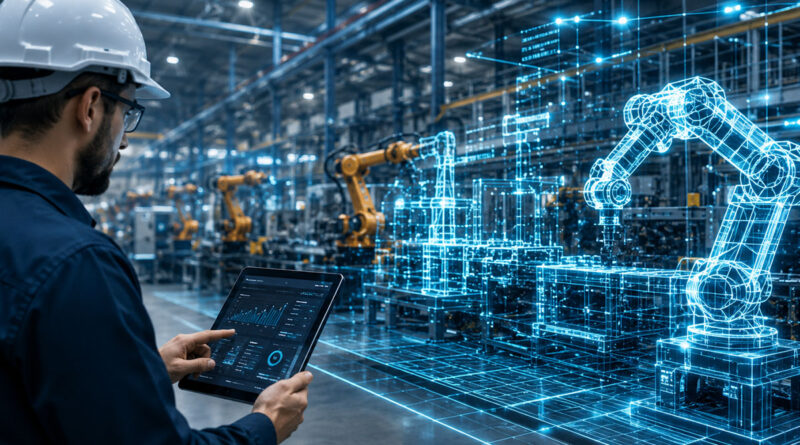
Digital twins are changing the industry
Digital twins in industry are becoming the foundation of modern factories
How digital twins work and why companies are investing billions in Digital Twin technology
Logistics, energy, and smart buildings are increasingly using digital twins
Digital twins could change the future of industry, but Europe still faces a major challenge
Digital twins in industry are becoming the foundation of modern factories
Until a few years ago, digital twins in industry remained a solution used primarily by the aerospace sector and major technology companies. Today, the technology is increasingly being adopted in logistics, energy, automotive, construction, and manufacturing. Companies are beginning to recognize that a digital factory model allows them not only to analyze processes in real time but also to predict failures, reduce energy consumption, and test costly investments without the risk of production disruptions.
In practice, a digital twin means a dynamic, constantly updated copy of a real facility, process, or entire enterprise. The system collects data from IoT sensors, ERP platforms, MES systems, and industrial infrastructure. It then analyzes it using artificial intelligence algorithms and creates a digital image of the plant’s operations.
A decade ago, many factories reacted to problems only when failures occurred. Today, more and more companies are trying to anticipate risks earlier. This is why experts are increasingly calling Digital Twin technology one of the most important pillars of Industry 4.0.
The market scale is also changing. According to MarketsandMarkets’ analysis, the global digital twin market could exceed $110 billion by the end of the decade. Growth is being driven by the development of artificial intelligence, industrial automation, increasingly affordable sensors, and increasing pressure to reduce operating costs.
The technology is no longer a futuristic vision presented at industry conferences. Digital twins are already operating in real-world production facilities and are increasingly responsible for decisions worth millions of euros. BMW uses digital factory models to plan production and optimize the flow of components between assembly lines. Siemens is developing one of the most advanced digital factories in Europe in Amberg, Germany, where a significant portion of production processes are automated and continuously analyzed by data systems. General Electric has been using Digital Twin technology for years in the energy and aviation sectors, where even a brief infrastructure downtime can generate significant operating costs.
The very philosophy of production management is also undergoing a growing shift. Companies no longer want to solely monitor machines. They want to predict the behavior of entire industrial processes.
This is particularly important in times of rising energy prices, unstable supply chains, and cost pressures. Traditional production management models are proving too slow in the face of dynamic economic changes. Companies need systems capable of analyzing thousands of data points almost instantly.
Digital twins enable a shift from a “fix problems” model to a “predict problems” model. This shift could prove to be one of the greatest industrial transformations of recent decades.
Experts point out that technology is beginning to combine several strategic trends simultaneously. Digital Twins are increasingly integrated with robotics, artificial intelligence, intelligent construction, and modern logistics. This means that digital twins are no longer merely analytical tools. They are increasingly becoming a central enterprise management system.
How Digital Twins Work and Why Companies Are Investing Billions in Digital Twin Technology
Data remains the foundation of Digital Twin technology. The more accurate the information fed into the system, the more precise the digital enterprise model becomes.
Modern industrial plants equip machines with sensors that monitor temperature, vibration, energy consumption, pressure, humidity, and equipment performance. The data is then transferred to cloud platforms using artificial intelligence and machine learning.
The system, however, goes beyond simply collecting information. The digital twin analyzes the relationships between processes and simulates various operational scenarios.
If a specific machine begins to consume more energy than usual, the system can predict a potential failure before a real problem occurs. If the flow of goods in a warehouse changes, the platform can identify a more efficient logistics solution. If energy prices rise, the system can suggest optimizations for production lines at specific times.
Predictive maintenance remains one of the most important reasons for implementing Digital Twin technology today.
According to reports from Deloitte and McKinsey, unplanned production downtime generates billions of dollars in losses in global industry. The problem isn’t limited to repair costs. A single production line failure can cause delivery delays, disrupt logistics, and impact the entire supply chain.
A good example is the collaboration between BMW and NVIDIA on the Omniverse project. The company created virtual models of production plants, allowing it to simulate changes in logistics, component flow, and workflow before implementing them in a real factory. This allows the company to detect potential process overloads early and reduce the risk of costly production errors.
It is precisely these implementations that demonstrate that Digital Twin is no longer an add-on to Industry 4.0. Technology is beginning to influence real-world strategic decisions.
Experts also emphasize the importance of digital twins in energy-intensive sectors. Rising energy prices are forcing companies to seek new methods for optimizing industrial processes.
Digital Twin allows for the analysis of energy consumption by individual production lines, equipment efficiency, heat loss, and the efficiency of the entire plant. In practice, companies can more quickly identify areas generating the highest costs and implement optimization measures before serious operational issues arise.
The technology is also being used in the design of new factories. Engineers are increasingly creating virtual plant models before infrastructure construction begins. They then test various operational scenarios.
This approach allows for early analysis of production line throughput, robot deployment, process safety, and internal logistics efficiency. Companies can detect design errors before investment begins and reduce the risk of costly mistakes.
In practice, this represents a significant shift in industrial philosophy. Just a few years ago, companies built factories and only then optimized their operations. Today, they increasingly test entire plants in a digital environment before embarking on the actual investment.
The combination of digital twins with generative artificial intelligence is also playing an increasingly important role. AI can analyze vast amounts of production data and propose process optimizations. In the future, systems may autonomously recommend changes to production organization or energy management.
This is precisely the element that is beginning to generate the greatest market interest. Companies want not only to monitor data but also to automatically draw conclusions from it.
Experts point out, however, that the effectiveness of the technology depends on the quality of the data. Inaccurate sensors, poorly integrated IT systems, or faulty analytical models can lead to incorrect business decisions.
Therefore, implementing Digital Twin technology requires not only purchasing new software but also redesigning the entire approach to data management within the enterprise. For many organizations, data integration remains the greatest challenge of digital transformation today.
Logistics, energy and smart buildings are increasingly using digital twins
Although the technology is most often associated with the manufacturing industry, digital twins are also developing at an increasing pace in logistics, energy, and modern construction.
This is clearly visible in the logistics industry.
Automated warehouse operators use digital models to analyze the flow of goods and plan the work of autonomous robots. The systems can predict warehouse congestion, analyze process efficiency, and indicate the most efficient transport paths.
This is especially important during the rapid growth of e-commerce and the growing pressure to shorten delivery times.
Large logistics centers today analyze thousands of data points in real time. Digital twins help optimize vehicle traffic, sorter operation, warehouse space utilization, and energy consumption. This allows operators to reduce delivery delays and increase the efficiency of the entire logistics chain.
The technology is also being used in multimodal transport.
The Port of Rotterdam is testing solutions that allow for the creation of digital models of port infrastructure and container traffic. The system analyzes data on weather, ship traffic, and terminal capacity. This allows operators to respond more quickly to logistical disruptions and reduce delays.
Experts point out that similar solutions could also play a crucial role in modernizing European rail infrastructure. These systems allow for predicting network congestion, analyzing infrastructure conditions, and planning repairs more efficiently.
Technology is also playing an increasingly important role in the energy sector.
Rising energy prices and the development of renewable energy sources require grid operators to analyze energy flows and system stability with increasing precision. Digital twins help monitor wind farms, photovoltaic installations, energy storage facilities, and transmission infrastructure.
Virtual models allow for the prediction of overloads and the analysis of the impact of new energy sources on the operation of the entire energy system. This is particularly important in Europe, where the energy transition is accelerating faster than the modernization of transmission infrastructure.
Technology is also becoming increasingly important in modern construction.
Digital twins of buildings enable the monitoring of energy consumption, the analysis of installation parameters, and the optimization of operating costs. Smart buildings today utilize vast amounts of data from HVAC systems, motion sensors, and energy management systems.
Digital Twins integrate all information into a single analytical environment.
This allows property owners to reduce energy consumption, predict system failures, improve occupant comfort, and analyze building energy efficiency. In times of rising energy prices and increasingly restrictive climate regulations, such solutions could become standard in modern commercial construction.
Experts note that technology will likely play a significant role in the development of smart cities. Local governments are beginning to test digital models of urban infrastructure, including public transport, energy networks, water management, and security systems.
In the future, cities will increasingly use real-time data to manage traffic, energy, and critical infrastructure.
This demonstrates that Digital Twin technology is no longer just an industrial solution. It is increasingly becoming a component of a broader digital transformation of the entire economy.
Digital twins could change the future of industry, but Europe still faces a major challenge
Despite its enormous potential, implementing Digital Twin technology remains a significant challenge for many companies.
Cost remains the biggest barrier.
Building a digital factory model requires investments not only in software but also in sensors, IT infrastructure, cybersecurity, and data integration. For medium-sized enterprises, adopting the technology may require rebuilding the entire production environment.
In many plants, outdated infrastructure also poses a problem. Older industrial systems were often not designed for integration with modern analytical platforms. Therefore, companies must modernize not only the software but also some of the machines and network infrastructure.
Cybersecurity remains a significant challenge.
Digital twins process vast amounts of data related to production processes, logistics, and critical infrastructure. An attack on such a system could paralyze the operation of a company or lead to the leak of strategic industrial data.
Experts emphasize that with the development of Industry 4.0, the importance of protecting operational data is growing. Cyberattacks on the industrial sector are becoming increasingly sophisticated, and production infrastructure is increasingly dependent on digital systems.
The lack of specialists also remains a problem.
Implementing Digital Twin technology requires knowledge in industrial automation, data analysis, cybersecurity, AI, and production process management. Meanwhile, many companies are already facing a shortage of technology experts.
The impact of technology on the labor market is also increasingly being questioned.
Process automation, the development of robotics, and analytical systems may reduce demand for some operational positions. At the same time, the demand for specialists capable of managing modern digital infrastructure is growing.
This means that industrial transformation will also require changes in employee education and training.
Europe is currently facing a challenging time. On the one hand, European industry remains among the most technologically advanced in the world. On the other, it is increasingly facing competition from the United States and China, which are investing enormous amounts in artificial intelligence, automation, and digital infrastructure.
This is precisely why technologies like Digital Twin may become not so much a development option for European companies as a prerequisite for maintaining competitiveness.
Much suggests that digital twins will become a standard element of modern industrial plants in the coming years. The development of AI, the Internet of Things, and increasingly affordable sensor systems are gradually making the technology more accessible to mid-sized businesses.
The most likely scenario is that the future of industry will increasingly rely on virtual environments. Companies will first test changes in the digital world and only then implement them in a real factory.
In a few years, it may turn out that building a large industrial project without first creating a digital model will be as risky as designing a modern aircraft without computer simulations.
This is precisely the direction in which modern industry is heading today.
Bibliography
Abramovici, M., Göbel, J.C., Dang, H.B., Semantic data management for the development and continuous reconfiguration of smart products and systems, CIRP Annals, Volume 65, Issue 1, 2016.
Kritzinger, W., Karner, M., Traar, G., Henjes, J., Sihn, W., Digital Twin in manufacturing: A categorical literature review and classification, IFAC-PapersOnLine, Volume 51, Issue 11, 2018.
Tao, F., Zhang, H., Liu, A., Nee, A.Y.C., Digital Twin in Industry: State-of-the-Art, IEEE Transactions on Industrial Informatics, Vol. 15, No. 4, 2019.
Jones, D., Snider, C., Nassehi, A., Yon, J., Hicks, B., Characterizing the Digital Twin: A systematic literature review, CIRP Journal of Manufacturing Science and Technology, Volume 29, 2020.
McKinsey & Company, Digital twins: The key to smart manufacturing, McKinsey Digital, 2024.
Deloitte Insights, Digital twins in industrial manufacturing: Enhancing asset lifecycle management, Deloitte Center for Integrated Research, 2024.
Gartner, Top Strategic Technology Trends for 2025: Digital Twins and Intelligent Systems, Gartner Research, 2025.
MarketsandMarkets Research, Digital Twin Market – Global Forecast to 2030, MarketsandMarkets, 2025.
Siemens AG, Digital Enterprise and Digital Twin Applications in Smart Manufacturing, Siemens White Paper, 2024.
NVIDIA, BMW Group Builds Factory of the Future with NVIDIA Omniverse, NVIDIA Industry Case Study, 2024.
IBM, What is a Digital Twin?, IBM Technology Insights, 2024.
World Economic Forum, The Future of Industrial Automation and Smart Factories, WEF, 2024.
International Energy Agency (IEA), Digitalization and Energy Systems, IEA Publications, Paris, 2024.
European Commission, Industry 5.0: Towards a sustainable, human-centric and resilient European industry, European Union Publications Office, 2024.
Nature Reviews Electrical Engineering, Digital twins for industrial infrastructure and energy systems, Springer Nature, 2024.


