
Living plastic with bacteria: PCL biodegradation in 6 days
Living plastic with bacteria: PCL biodegradation in 6 days
Living plastic: why scientists chose PCL
Two enzymes, one goal: breaking down the polymer without creating microplastics
Six days under controlled conditions: what the experiment really showed
From lab to industry: what needs to happen next
Living plastic with bacteria: PCL biodegradation in 6 days
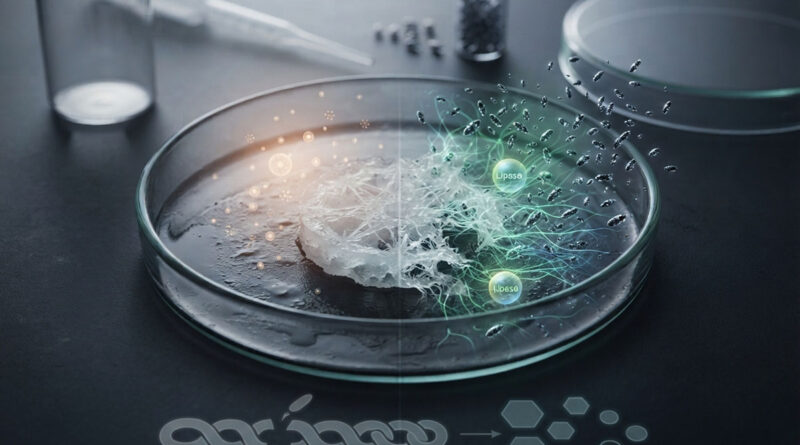
“Living plastic” could transform the way plastics are designed. Scientists have developed a material in which dormant Bacillus subtilis bacterial spores work in tandem with polycaprolactone (PCL); upon controlled activation, they trigger the enzymatic breakdown of the polymer. In a recent study published in ACS Applied Polymer Materials, the use of two cooperating enzymatic systems enabled the complete degradation of the material within six days. The researchers also used this approach to create a prototype flexible electrode that degraded after its service life ended.
The result is significant not because scientists found a way to make any plastic instantly “disappear”—that is not a conclusion that can be drawn from the study. The experiment involved a specific polymer, a specially prepared material, and particular activation conditions. The discovery’s importance lies elsewhere: researchers are attempting to embed the material’s end-of-life phase directly into its design, rather than treating disposal as a problem that arises only after the product has been used.
This approach aligns with a broader trend in research on materials designed with their entire lifecycle in mind. In the case of “living plastic,” biology is not used solely to produce the material; it becomes part of the mechanism responsible for its eventual degradation.
Living plastic: why scientists chose PCL specifically
The material developed is based on polycaprolactone (PCL)—a biodegradable polyester used in applications such as 3D printing and certain biomedical solutions. Its properties make it an interesting candidate for experiments with biodegradable plastics. However, its degradation rate is not always fast enough to meet the requirements for materials designed with a controlled, short lifecycle.
PCL possesses another significant characteristic: it can be processed using methods typical for many thermoplastics. This is important because a major challenge in incorporating enzymes into polymer materials is their sensitivity to manufacturing conditions; high temperatures and mechanical processing can diminish the activity of biological components.
For this reason, Zhuojun Dai’s team opted against simply adding an active enzyme to the plastic. Instead, the researchers utilized Bacillus subtilis spores. In this form, the bacteria remain dormant and are far more resilient to harsh conditions than active cells. This allowed them to be incorporated into the PCL matrix without significantly compromising the material’s physical properties—an approach the researchers had previously presented in a study published in Nature Chemical Biology.
In the initial phase of the research, the scientists genetically modified Bacillus subtilis so that, upon activation, the spores would produce a lipase derived from Burkholderia cepacia—an enzyme responsible for breaking down PCL. The spores were combined with polycaprolactone to create a material that retained its physical properties during use but could undergo near-complete depolymerization once activated.
The latest study builds upon this concept. Researchers concluded that a single enzyme might not be the most effective solution, as the breakdown of long polymer chains occurs in stages. Consequently, instead of a single mechanism, they employed two cooperating enzyme systems.
This shift is precisely one of the key elements of the new solution.
Two enzymes and one goal: to break down the polymer without creating microplastics
A polymer is composed of long chains. To effectively degrade it, merely disrupting its structure is insufficient; the resulting fragments must be broken down further.
In the system developed, one enzyme acts as a “cutter.” Candida antarctica lipase targets the long PCL chains and cleaves them into shorter fragments. A second enzyme—Burkholderia cepacia lipase—continues the process, breaking down the resulting products into the polymer’s basic building blocks. The ACS vividly describes these two mechanisms as a collaborative system: one cuts the long chains, while the other gradually breaks down the resulting fragments.
This is highly significant from a materials engineering perspective. Merely breaking a plastic down mechanically or chemically does not equate to biodegradation; the material might be reduced to increasingly smaller particles yet still persist in the environment. The researchers sought to avoid this scenario with their solution.
According to the study’s authors, the interplay between the two enzymes enabled the material’s complete breakdown without generating microplastic intermediates. The ACS emphasizes that the efficiency of this enzymatic cooperation prevented the process from stalling at the stage where smaller fragments are formed.
The mechanism can thus be simplified into three successive stages. First, dormant spores are activated. Next, the bacteria begin producing enzymes. Finally, the enzymes break down the PCL structure—first by cleaving the long chains, and subsequently by further breaking down the resulting fragments.
This is not, however, a simple mixture of bacteria and plastic. The researchers employed genetic engineering to program the bacteria to perform specific functions. That is precisely why the term “living plastic” is more than just a catchy slogan in this instance. The material’s biological component serves a specific, engineered function.
At the same time, the spores do not remain active throughout the material’s entire service life; their dormant state allows the plastic to retain its functionality. The biological system only springs into action following appropriate activation. This solution demonstrates an interesting shift in thinking about biodegradable plastics. The conventional approach assumes that the material should simply be susceptible to decomposition under the right conditions. Here, however, scientists are attempting to create a material whose degradability is an integral part of a designed lifecycle.
Six days in controlled conditions. What the experiment really showed
The study’s most spectacular result can be summed up in two words: six days.
In the experiment, following spore activation, the PCL material completely degraded within six days. Activation was triggered using a growth medium at a temperature of approximately 50°C. This is a crucial detail, as it demonstrates that the six-day timeframe does not imply that any object made from this material will spontaneously disintegrate in the environment on its own; rather, it represents a result obtained within a specific experimental setup.
This distinction is also vital when communicating about biodegradable plastics. The slogan “plastic disappears in six days” makes for a catchy headline, but without further explanation, it could lead to misconceptions.
In reality, the study reveals something more intriguing: the material can retain its functional properties and then—once the biological system is properly triggered—undergo a rapid degradation process.
The researchers also tested this concept using a device. They fabricated a flexible electrode for wearable applications from the material. The prototype functioned as intended and, following activation, completely degraded within about two weeks. By comparison, a similar component made from a commercial plastic did not break down in this manner.
This serves as an important proof of concept, demonstrating that the solution is not limited to small material samples observed solely under laboratory conditions. The scientists constructed a functional electronic component and subsequently verified its ability to degrade. However, this does not yet amount to a finished industrial product.
There are many stages between the prototype and actual implementation. A material intended for mass production must possess stable properties, predictable durability, a suitable price point, and a repeatable manufacturing process. It must also meet the safety and usage requirements specific to the product in question.
In the case of “living plastic,” there is the additional challenge of controlling the biological component. Scientists must ensure that the spores remain dormant during production, transport, and use, and that the degradation process can be triggered only when it is truly necessary.
This is one reason why controlled activation is so crucial. The study employed a temperature of approximately 50°C and a nutrient medium to trigger the spores. While this approach proved successful in the experiment, future applications will require the development of other, more practical activation methods.
The authors have, in fact, indicated a specific direction for future work. They aim to develop a mechanism that allows the spores to be activated in water, given that a significant amount of plastic waste ends up in aquatic environments. However, this is a goal for future research rather than a feature of the material presented here.
From laboratory to industry: what needs to happen next
It would be a major mistake to regard this new material as a ready-made solution to the plastic waste problem; the study does not suggest this.
Its significance lies elsewhere. Researchers have demonstrated that polymer engineering, biotechnology, and synthetic biology can be combined to create a material with degradation properties programmed at the design stage.
This could be particularly relevant for products with short or strictly defined lifespans. If an item does not need to remain durable for decades, there is not always a reason for the material from which it is made to retain its structural integrity for just as long.
Wearable electronics represent one potential application. A prototype electrode demonstrates that the material can simultaneously serve a functional purpose and incorporate a designed end-of-life mechanism. While similar approaches could be explored for other applications in the future, at this stage, the material should not be presented as a market-ready technology. The authors themselves emphasize that research to date has focused on PCL, although a similar strategy could be considered for other plastics.
Scaling up production remains a significant challenge. Laboratory-grade material can be produced under conditions that are difficult to replicate in industrial manufacturing. Materials containing a biological component introduce additional requirements regarding stability, uniform distribution within the matrix, and process control.
Economic factors also play a role. Even if the material performs as intended, the industry will need to determine whether its production costs can compete with existing plastics. At this stage, the study provides no basis for estimating the material’s future price or its economic viability at a mass-production scale. Another issue is biosafety. The project employs genetically modified Bacillus subtilis, with spores programmed to produce enzymes that break down PCL. While the mere use of microorganisms does not automatically imply a risk, any technology based on modified organisms requires appropriate safety assessment and oversight during further development. The study focuses primarily on the material’s functionality and degradation mechanism; therefore, broad conclusions regarding future environmental applications should not be drawn from it at this stage.
It will also be crucial to determine exactly what happens to the biological component once degradation is complete. This is particularly important if such materials are ever to be used outside of controlled facilities.
This is precisely why the most interesting aspect of this technology is not that the plastic is “alive,” but rather the ability to engineer its end-of-life phase.
Previous research by the team demonstrated that dormant Bacillus subtilis spores could be used to create a PCL material that retains its properties while the microorganisms remain inactive. Upon activation, the bacteria begin producing the enzyme that breaks down the polymer.
The latest work takes this a step further. Two cooperating enzyme systems enable faster and more effective degradation, and the authors have also demonstrated a practical prototype of a flexible electrode.
Thus, “living plastic” should be viewed not as a ready-made replacement for all existing plastics, but as a new strategy for material design. Its fundamental premise is simple: a product should be durable when needed, but its durability need not be indefinite. If further research enables the development of effective activation mechanisms for various environments, improves scalability and production economics, and addresses safety concerns, similar materials could find application in selected industry segments.
However, the most accurate conclusion at present is more specific. No plastic has been created that simply vanishes from any environment after six days. Instead, a material has been developed whose biologically programmed degradation can be effectively triggered under controlled conditions. This is a fundamental distinction, yet it is precisely what makes research into “living materials” so compelling.
The future of this technology will depend not merely on the laboratory result itself, but on whether scientists can successfully transition this controlled degradation mechanism from the experimental stage to real-world manufacturing processes and waste management systems.
If successful, future plastics could be designed not only with the question “how long should it last?” in mind, but also by asking, “what should happen to it when it is no longer needed?”
References
Tang, C., Sun, J., Wang, Q. et al. (2026). Degradable Living Plastics Programmed by Engineered Microbial Consortia. ACS Applied Polymer Materials, 8(8), 5496–5506. DOI: 10.1021/acsapm.5c04611.
Tang, C., Wang, L., Sun, J. et al. (2025). Degradable living plastics programmed by engineered spores. Nature Chemical Biology, 21, 1006–1011. DOI: 10.1038/s41589-024-01713-2. Online publication: August 21, 2024; magazine edition: 2025.
American Chemical Society (2026). This ‘living plastic’ activates and self-destructs on command. ACS Science Releases, April 30, 2026