
Field of Vision – how haptic technology opens up sports to the blind
Field of Vision – haptic technology transforming sports accessibility
From camera feed to tactile information
More than just a device: part of a new model for stadium accessibility
Key challenges: precision, latency, and natural usability
Will haptic technology become the standard for the future of sports?
A true technological innovation
Field of Vision – haptic technology transforming sports accessibility
For decades, sports stadiums were designed primarily with the visual experience in mind. The ball’s position, player movements, team formations, and the moment a goal is scored are all details that reach most fans through sight. However, for the blind and those with severe visual impairments, sports have always required the use of alternative information channels. Radio commentary, audio description, and assistance from others made it possible to follow the action, yet they failed to provide a true sense of independent participation.
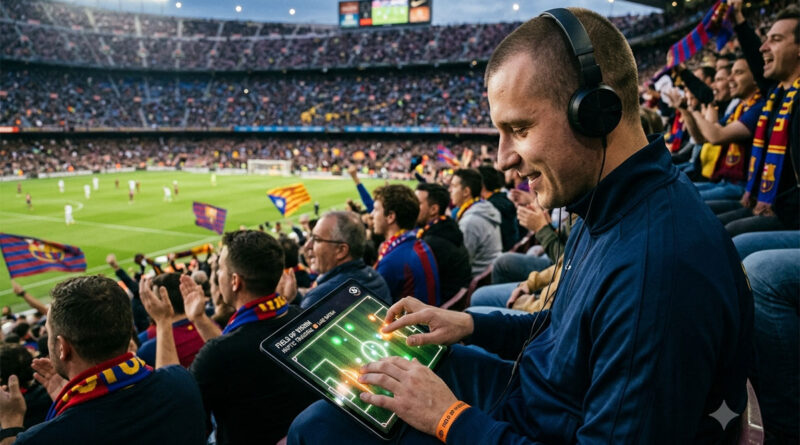
The development of haptic technology is beginning to change this model. One example of this approach is Field of Vision—a technology that employs artificial intelligence, image analysis, and tactile feedback to enable blind individuals to experience sporting events more directly.
The project, developed by the Irish startup Field of Vision, was not created merely as another electronic gadget. Its aim was to solve a specific problem: how to convey information about the dynamic action on the field to a blind person in a way that does not rely solely on another person’s interpretation.
It is precisely this aspect that makes the technology interesting—not only from the perspective of accessibility but also regarding the design of human-machine interfaces. After all, Field of Vision demonstrates that information traditionally associated with one sense can be translated into a different communication channel.
The project has also garnered attention beyond the tech community; Time magazine included Field of Vision in its list of the best inventions of 2022. This recognition highlighted the potential of technologies that foster greater accessibility at sporting events.
However, the true significance of this solution lies in more than just the device itself. The crucial question is: how do we transform the complex, dynamic reality of a match into information that a person can interpret quickly and intuitively through touch?
From camera image to information perceived through touch
The greatest challenge facing the creators of Field of Vision was not the detection of the ball itself. Modern artificial intelligence systems are becoming increasingly effective at analyzing images and recognizing objects in video footage. A far more difficult task is translating the vast amount of visual information into a simple message that the user can grasp almost instantly.
A football match is an exceptionally demanding environment for analytical technologies. The ball constantly changes position, players move across the entire pitch, and the situation can shift in a matter of seconds. Consequently, the system must not only identify the object but also determine its location and convey that information in an appropriate format. Field of Vision achieves this by combining computer vision with haptic technology. Cameras capture the action, and algorithms analyze data regarding the ball’s movement. This information is then transmitted to a specialized device that the user can operate via touch.
A key component of the solution is a physical interface that maps the ball’s position. Users can track its location by moving their fingers across the device’s surface. This allows them to go beyond receiving a single, static message and instead build their own mental picture of the situation.
It is precisely this element that distinguishes haptic technology from traditional audio description. Commentary describes events and conveys a third party’s interpretation, whereas a tactile interface enables users to independently analyze aspects of the game’s progression.
However, this does not mean that haptics replace sound; the two channels can complement each other. Audio description provides context-such as player names, referee decisions, or the significance of a specific play—while tactile technology supplies spatial information.
From a user experience design perspective, this represents a significant shift. The technology does not attempt to replicate sight or create an artificial visual copy; instead, it designs a new way of accessing information.
This approach aligns with the evolution of multisensory technologies, which increasingly utilize various channels to communicate with users. In the future, similar solutions could be applied not only in sports but also in education, navigation, and other fields requiring the translation of visual information.
Not just a device, but an element of a new model of stadium accessibility
The development of technologies like Field of Vision reflects a broader shift within the sports industry. The modern stadium is increasingly evolving beyond a mere venue for athletic competition; it is becoming a comprehensive experience platform that integrates physical infrastructure, digital systems, and the needs of diverse audience groups.
For stadium operators and event organizers, accessibility long meant primarily physical adaptations—such as appropriate entrances, seating for individuals with limited mobility, and features facilitating navigation within the facility. Digital technologies, however, are expanding this approach. Today, the question is no longer just “Can this person enter the stadium?” but also “Can they fully participate in the event?”
In this context, Field of Vision aligns with the principles of universal design. This approach entails creating products and services that account for the needs of the widest possible user base from the very outset. The goal is not to devise add-on solutions only after a barrier arises, but to design experiences that are accessible to diverse audiences from the start.
For sports clubs and event organizers, such solutions can also hold strategic importance. Sport is rooted in emotion and the bond between fan and team. If a segment of the audience has limited ability to experience the event, the organization misses the opportunity to forge a complete connection with that group.
Consequently, technologies that enhance the sports experience can become a key element of a broader strategy for building a fan community. Accessibility is no longer viewed merely as a regulatory requirement or a social responsibility initiative; increasingly, it is becoming an integral part of the overall quality of the experience offered by the sports venue. At the same time, implementing such solutions requires an appropriate technological approach. Creating a device for the end user is merely one component of the entire system. For the technology to function during an actual event, it must integrate with the infrastructure responsible for data delivery.
In top-level sports, factors such as transmission stability, information processing speed, and the ability to operate under varying conditions are crucial. A stadium is a dynamic environment: the number of users fluctuates during each event, and technical conditions can differ from one venue to another.
Consequently, the future of such solutions will depend not only on the device itself but also on scalability. Technology designed for a single user may serve as an interesting prototype; however, the real challenge lies in creating a system that is accessible to a large number of fans and can be implemented by various sports organizations.
Key challenges: precision, latency, and natural handling
Designing haptic technology for sports requires addressing challenges not found in many other AI applications. In standard image analysis, a system simply detects an object and records the result; however, when it comes to the fan experience, that information must also be effectively conveyed to the human user.
The primary challenge is minimizing the latency between an event on the field and the device’s response. A fan watching a match expects real-time information; if a notification arrives too late, the experience loses its natural feel.
This issue is particularly pronounced in fast-paced sports. In soccer, a delay of just a few seconds could mean the user receives information about a situation that has already concluded. Consequently, designers must strike a balance between analysis accuracy and system speed.
A second challenge lies in the method of information delivery. Humans can only process a limited number of stimuli simultaneously; an overload of notifications could hinder the device’s usability rather than enhance it.
Designing a haptic interface therefore requires an understanding of human perception. The goal is not to transmit every piece of data present in the image, but rather to select the information that is most meaningful to the user.
This approach mirrors the design of other digital interfaces. A well-designed system does not convey everything it knows; instead, it provides the user with precisely the information needed to perform a specific action.
This is especially critical for Field of Vision, as the user is not operating the technology in a controlled test environment, but rather during an exciting live event, amidst a multitude of other stimuli, sounds, and crowd reactions.
Ultimately, the success of such solutions depends not only on technical capabilities but also on the quality of the user experience.
Will haptic technology become the standard in the sports of the future?
Field of Vision points to a potential direction for the future of accessibility in sports events. However, this does not mean that every technological solution will automatically become a universal standard. The journey from an innovative design to widespread adoption involves overcoming numerous obstacles.
Implementation cost remains one such hurdle. Sports organizations must assess how the technology aligns with their financial capabilities and existing infrastructure. A solution must be not only effective but also sustainable and manageable to operate.
Collaboration among technology developers, sports clubs, stadium operators, and the users themselves will also be crucial. It is the end-users who best demonstrate which features offer genuine value and which require further development.
The future may see the integration of haptic technology into an increasing number of systems used at sporting events. Advances in artificial intelligence, automated image analysis, and high-speed data transmission could pave the way for more sophisticated experiences.
This does not, however, imply replacing traditional sports with technology. The goal of such solutions is not to alter the nature of the competition, but to remove barriers that have long excluded some fans.
Thus, the greatest value of Field of Vision lies not merely in its status as a modern device; its significance stems from the new mindset regarding accessibility that it embodies.
Technology can do more than just assist with specific tasks; it can transform the way people engage with culture, sports, and social life.
In this sense, Field of Vision exemplifies a broader trend: the shift from assistive technologies to technologies that enable fuller participation.
True technological innovation
Field of Vision demonstrates that the future of sports will depend not only on the development of technologies used by athletes and analysts but also on solutions designed for the fans themselves.
The combination of artificial intelligence, image analysis, and haptic technology creates a new way of conveying information to the blind. However, the most important element is not the electronics themselves, but a shift in perspective: moving from merely enabling presence at the stadium to facilitating full participation in the event.
Solutions like Field of Vision show that accessibility can be a realm of genuine technological innovation. In the future, similar systems could become part of designing sports that are more inclusive and tailored to the diverse needs of the audience.
Bibliography
Field of Vision – official website of the project
James Dyson Award – Field of Vision project
TIME – The Best Inventions of 2022, https://time.com/collections/best-inventions-2022/
Mada Innovation Program – Field of Vision solution profile