
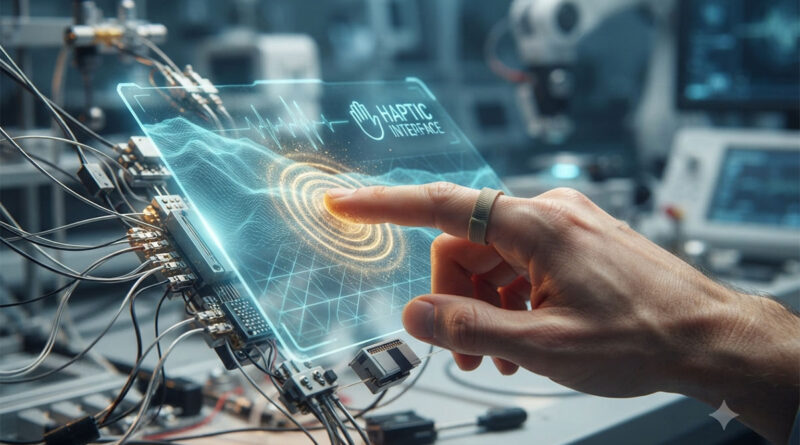
What is haptic technology?
How digital touch is transforming smartphones, robotics, and medicine
Haptic technology in consumer electronics
Haptic technology in robotics and industry
Challenges and the future of haptic technology
Evolution of the field
How digital touch is transforming smartphones, robotics, and medicine
Until relatively recently, haptic technology was primarily associated with simple vibrations in mobile phones or game controllers. Today, it represents one of the most important areas of development for human-machine interfaces. It enables digital devices to convey information not only through sight and sound but also through the sense of touch. Haptic technology allows for the simulation of pressure, resistance, and vibration—and, in more advanced solutions, even specific physical properties of objects.
The development of this field stems from a simple fact: humans do not perceive the world solely through sight and hearing. Touch plays a crucial role in daily life, enabling us to assess shape, texture, temperature, and the force required to perform specific actions. Research into haptic perception shows that the human nervous system processes multiple types of stimuli simultaneously; their correct interpretation allows for precise movements and informed decision-making.
This is precisely why engineers have long sought to bring the natural experience of touch into the digital realm. Early solutions were limited to simple warning signals. Today, however, haptic systems employ advanced actuators, sensors, and control algorithms that enable the creation of more complex forms of feedback.
Haptic technology is applied across many economic sectors. Smartphone manufacturers use it to enhance device usability. Virtual reality developers employ it to deepen user immersion. Medical professionals use simulators equipped with haptic feedback for surgical training. Meanwhile, the industrial sector utilizes it in collaborative robots and remote control systems.
However, creating a realistic digital sense of touch is by no means a simple task. The human sense of touch is one of the most complex perceptual systems. Replicating all its properties requires combining knowledge from the fields of electronics, mechanics, computer science, neurobiology, and interface design.
Haptic technology in consumer electronics
Consumer electronics was one of the first sectors where haptic technology reached the mass market. Smartphones remain the most prominent example, having replaced traditional vibration motors with more precise actuators.
Modern haptic systems do more than just generate a single pulse; they can create various vibration patterns corresponding to specific user actions. Different signals can indicate an interface interaction, confirm an operation, or signal a system notification.
This approach improves human-device communication. Users do not need to keep their eyes constantly fixed on the screen, as they receive some information through touch. This is particularly important in situations where a quick reaction is more critical than closely monitoring the interface.
Haptic technology is also evolving toward so-called surface haptics. Traditional touchscreens are physically smooth surfaces, meaning users do not receive the natural tactile feedback associated with mechanical buttons. Research into surface haptic systems focuses on creating sensations of texture, resistance, or localized pressure without the need for conventional moving parts.
One area of development involves technologies that utilize electrostatic fields and ultrasound. These allow for the modification of how a finger perceives contact with a surface. In the future, such solutions could be applied not only in smartphones but also in automotive control panels, medical devices, and industrial systems.
However, it is worth noting that the mere presence of haptic feedback does not guarantee a superior user experience; designers must carefully select the intensity, duration, and nature of the stimuli. A signal that is too weak may go unnoticed, whereas one that is too strong can cause discomfort. Consequently, modern haptic design increasingly relies on research into user behavior and the analysis of human perception. Haptic technology in virtual reality and medicine. One area where haptic technology is particularly significant is virtual and augmented reality. A realistic visual image alone is insufficient to create a full sense of presence in a digital environment. Humans engage multiple senses simultaneously when interacting with the real world; consequently, the absence of tactile information limits the level of immersion.
Haptic systems allow visual experiences to be complemented by information regarding physical contact. Motion controllers, gloves, and specialized devices equipped with force feedback can inform the user about contact with a virtual object, the direction of applied force, or the precise moment an action is performed.
The simplest solutions utilize localized vibrations. More advanced systems employ mechanisms that generate resistance to movement. This enables the user to perceive the difference between touching a lightweight object and attempting to move an object that requires greater force. Such solutions are particularly valuable in training, technical simulations, and medical education.
In medicine, haptic technology is evolving primarily as a tool to support physician training. Traditionally, learning many surgical procedures requires the repeated performance of specific actions under the supervision of experienced specialists. In contrast, simulators equipped with force feedback allow for the safe practice of movements and the analysis of how they are executed.
Precision is of paramount importance in surgery. During an actual procedure, a surgeon relies not only on sight but also on information derived from the contact between instruments and tissue. Robotic surgery limits the operator’s direct contact with the patient; therefore, replicating the natural sensation of force and resistance remains one of the greatest challenges. Haptic systems used in medical robotics are designed to provide physicians with feedback while controlling instruments inside a patient’s body. This enables better control over movements and reduces the risk of applying excessive pressure.
However, it must be emphasized that the application of haptics in medicine requires further research. Not every system developed in the laboratory finds immediate clinical application; it is essential to validate the technology’s effectiveness, ensure safety, and develop solutions suitable for implementation in everyday practice.
Haptic technology in robotics and industry
Robotics is another field where the importance of haptic technology is steadily growing. While modern industrial robots are capable of performing highly precise movements, for many years they lacked one of the most crucial elements of human perception: the ability to sense contact.
Human-robot collaboration requires not only observing the machine’s operation but also receiving rapid feedback on its behavior. Force sensors and feedback systems enable the operator to detect contact with an object, assess resistance, and control the task being performed.
This is particularly significant in teleoperation—a scenario in which a human controls a device located elsewhere. Such solutions are employed, for instance, in hazardous environments where human presence would pose a risk. Robots equipped with haptic systems can be used in space exploration, the operation of industrial facilities, and tasks carried out in environments hazardous to human health. An operator receiving haptic feedback can perform more precise movements than someone controlling a robot based solely on visual information.
The development of collaborative robotics is also driving the demand for haptic technologies. Robots working alongside humans must respond to physical contact and adjust their behavior accordingly. Information regarding contact force or the direction of applied force helps minimize the risk of product damage and enhances worker safety.
In the future, haptic systems could become a key element of more natural human-robot communication. Instead of using complex control panels, users will be able to perform movements that more closely resemble those used in everyday activities.
Challenges and the future of haptic technology
Despite its rapid development, haptic technology still faces significant limitations. The greatest challenge remains accurately reproducing the complexity of the human sense of touch.
Humans perceive tactile stimuli through many different types of receptors located in the skin. Each of these receptors is responsible for detecting different sensations, such as pressure, vibration, skin stretching, or changes in surface texture. As a result, a single vibration mechanism cannot realistically replicate the full experience of physical contact with an object.
For this reason, researchers are developing multimodal systems that combine different methods of generating tactile feedback. Current research includes flexible actuators, materials that change their properties in response to electrical impulses, and contactless haptic technologies based on ultrasound.
Miniaturization is another important challenge. Users expect devices to be lightweight, comfortable, and energy-efficient. However, advanced haptic systems require sufficient space for actuators, control electronics, and power sources.
Another challenge is the development of universal standards. At present, many solutions operate within closed ecosystems created by individual manufacturers. The lack of common communication standards may slow the widespread adoption of haptic technology.
The future of haptics will likely be closely linked to advances in artificial intelligence, robotics, and immersive devices. AI algorithms may help analyze user behavior and adapt haptic feedback to specific situations and individual needs.
However, this does not mean that haptic technology will completely replace traditional user interfaces. A more likely scenario is that it will become their natural complement. Just as visual and audio technologies have expanded the possibilities of digital communication, touch may become another important channel of interaction between humans and machines.
Development of the field
Haptic technology has come a long way—from the simple vibration mechanisms used in mobile phones and game controllers to advanced systems capable of conveying information about force, contact, and motion. Today, it is widely applied in consumer electronics, virtual reality, medicine, robotics, and industrial applications.
Its greatest value lies in its ability to create more natural communication between humans and technology. Touch is one of the most fundamental ways in which people perceive and interact with the world, and bringing this sense into digital environments opens new possibilities for designing interactive devices and systems.
The future development of haptic technology will depend on advances in electronics, materials science, artificial intelligence, and robotics. Although fully replicating the human sense of touch remains a significant challenge, current solutions demonstrate that haptic technology is no longer merely an additional feature of digital devices. Instead, it is increasingly becoming one of the key components of future human–machine interaction systems.
References
Basdogan, C., Giraud, F., Levesque, V., & Choi, S. (2020). A Review of Surface Haptics: Enabling Tactile Effects on Touch Surfaces. IEEE Transactions on Haptics, 13(2), 222–237. https://doi.org/10.1109/TOH.2020.2985396
Culbertson, H., Schorr, S. B., & Okamura, A. M. (2018). Haptics: The Present and Future of Artificial Touch Sensation. Annual Review of Control, Robotics, and Autonomous Systems, 1, 385–409. https://doi.org/10.1146/annurev-control-060117-105043
Hannaford, B., & Okamura, A. M. (2016). Haptics. In B. Siciliano & O. Khatib (Eds.), Springer Handbook of Robotics (pp. 719–742). Springer.
Hayward, V., Astley, O. R., Cruz-Hernandez, M., Grant, D., & Robles-De-La-Torre, G. (2004). Haptic Interfaces and Devices. Sensor Review, 24(1), 16–29.
Lederman, S. J., & Klatzky, R. L. (2009). Haptic Perception: A Tutorial. Attention, Perception, & Psychophysics, 71(7), 1439–1459. https://doi.org/10.3758/APP.71.7.1439
Okamura, A. M. (2009). Haptic Feedback in Robot-Assisted Surgery. Current Opinion in Urology, 19(1), 102–107.
Pacchierotti, C., Sinclair, S., Solazzi, M., Frisoli, A., Hayward, V., & Prattichizzo, D. (2017). Wearable Haptic Systems for the Fingertip and the Hand: Taxonomy, Review, and Perspectives. IEEE Transactions on Haptics, 10(4), 580–600. https://doi.org/10.1109/TOH.2017.2689006


