Digital twins and artificial intelligence
Digital twins and artificial intelligence – how autonomous factories of the future are being created
How does the integration of digital twins and AI work in the industrial environment?
Practical applications – from prediction to autonomy
Benefits, challenges, and directions of development of autonomous factories
Digital twins and artificial intelligence – how autonomous factories of the future are being created
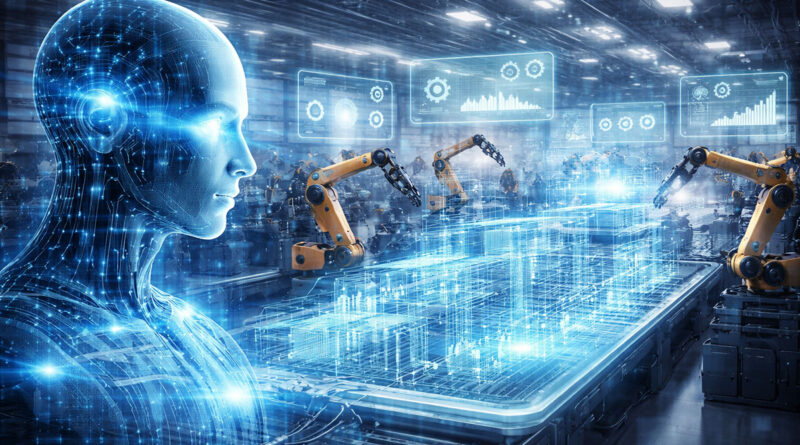
Digital twins and artificial intelligence are currently one of the most important development directions in modern industry, enabling a shift from traditional operational management to a model based on data and automated decision-making. Integrating these technologies allows enterprises not only to map production processes but also to analyze them in real time and dynamically optimize them. As a result, organizations increase efficiency, reduce costs, and build a competitive advantage in an environment of increasing market volatility.
A digital twin provides a detailed representation of physical systems, while artificial intelligence analyzes data and translates it into specific operational actions. This combination enables continuous monitoring, simulation, and process optimization. According to analyses by McKinsey and IBM, implementing solutions based on AI and digital twins can lead to productivity increases of several percent and reduce operational downtime by as much as 30–50%, which directly translates into companies’ financial results.
How does the integration of digital twins and AI work in an industrial environment?
The integration of digital twins and artificial intelligence relies on a continuous flow of data between the physical environment and its digital representation. IoT systems collect data from machines, which are then transferred to the digital twin, where they are processed and analyzed. The digital model reflects the current state of the system and enables simulations of various operational scenarios.
AI uses this data to identify patterns and create predictive models that allow for future events to be predicted. In practice, this means that companies can predict failures, optimize production processes, and adjust machine operating parameters in real time. This approach allows for a shift from reactive management to a predictive model, where decisions are made based on data rather than experience alone.
Technological infrastructure, including cloud computing and edge computing solutions, plays a key role. These enable rapid data processing and the implementation of algorithms directly in the operational environment. The result is systems capable of autonomous operation, analyzing data, simulating scenarios, and making decisions without the need for human intervention.
Practical applications - from prediction to autonomy
The integration of digital twins and artificial intelligence is used in many industrial sectors, but is most important in production optimization, maintenance, and supply chain management. Systems utilizing these technologies monitor machine health, analyze operational data, and predict potential failures, reducing the risk of downtime and increasing process reliability.
In the energy sector, turbine digital twins work with AI algorithms to optimize equipment operation and increase efficiency. The systems analyze temperature, load, and consumption data and then recommend optimization measures. In the manufacturing industry, these solutions enable dynamic adjustments to production line parameters, resulting in improved quality and reduced material waste.
In logistics, the integration of AI and digital twins enables real-time data analysis and supply chain optimization. Systems can predict changes in demand, optimize transportation routes, and manage warehouse resources. As a result, companies increase operational flexibility and shorten order fulfillment times. This approach leads to a gradual transition from decision-support systems to autonomous solutions that manage processes independently.
Benefits, challenges and directions of development of autonomous factories
The integration of digital twins and artificial intelligence offers numerous benefits, including increased operational efficiency, cost reduction, and improved quality of production processes. These systems enable decision automation and real-time optimization of operations, which is the foundation for building autonomous factories.
However, implementing such solutions poses significant challenges. Organizations must invest in technological infrastructure, integrate various systems, and develop employee competencies. Data quality is crucial, as it is the data that AI algorithms rely on. Incorrect data can lead to incorrect decisions, limiting the effectiveness of the entire system.
According to analyses by Gartner, IBM, and McKinsey, technological advancements will lead to the increasing autonomy of industrial systems. Enterprises will create environments in which systems autonomously analyze data, make decisions, and optimize operational processes. Digital twins and artificial intelligence will become a key element of digital transformation, defining the future of industry and how organizations operate in a data-driven economy.
Bibliography
IBM – What is artificial intelligence?
https://www.ibm.com/topics/artificial-intelligence
IBM – What is a digital twin?
https://www.ibm.com/topics/what-is-a-digital-twin
McKinsey & Company – What is Industry 4.0?
https://www.mckinsey.com/featured-insights/mckinsey-explainers/what-are-industry-4-0-the-fourth-industrial-revolution-and-4ir
Gartner – Digital Twin
https://www.gartner.com/en/information-technology
Lee, J., Davari, H., Singh, J., Pandhare, V. (2018) – Industrial AI: Applications with Sustainable Performance
https://ieeexplore.ieee.org/document/8240462
Deloitte – Industry 4.0 and smart manufacturing
https://www2.deloitte.com/us/en/insights/focus/industry-4-0.html