
The hidden power of crops: potassium, magnesium and sulfur in modern fertilization
Precise fertilization instead of formulas
The role of key nutrients in modern fertilization and yield physiology
The impact of mineral fertilization on the structure and physical properties of soil
Fertilizer selection strategy based on their solubility and origin
Crop rotation optimization and modern on-farm testing
Precise fertilization instead of schemes
The role of key nutrients in modern fertilization is the foundation for high-efficiency plant production, which, in an era of rising input costs, is becoming a priority for every farmer. Marcin Matuszewski, who farms 100 hectares in the Września district, demonstrates that agricultural success depends on a deep understanding of soil characteristics and the precise supply of elements that are often overshadowed by nitrogen. Modern agricultural technology cannot rely solely on basic NPK formulas, because limited sulfur or magnesium availability drastically reduces plant yield potential, even with the highest doses of urea or nitrate. Proper fertilization is a complex biochemical process, in which each element performs a unique function, and their synergy determines the farm’s final economic outcome.
The role of key nutrients in modern fertilization and the physiology of yield
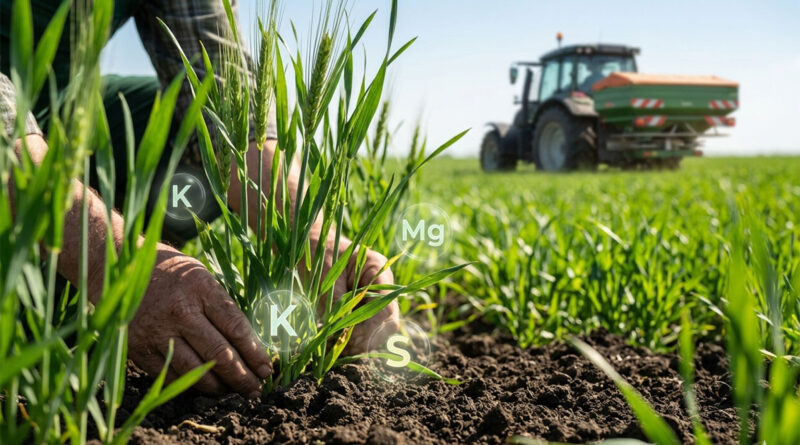
In modern agriculture, we often forget that a plant is a complex organism that requires much more than just nitrogen to build tissue. Potassium, magnesium, and sulfur are the three pillars that Marcin Matuszewski calls his “weapons” in the fight for yield and quality. Potassium plays a key role in this system as the main regulator of water management and cellular metabolism. Thanks to it, plant cells maintain appropriate turgor, which directly translates into crop resilience during periods of severe drought, which increasingly affect Polish fields during the critical spring growing season. This element also strengthens mechanical tissues, creating a natural protective barrier against attacks by pests and pathogens, reducing the need for intensive chemical protection.
Magnesium, in turn, forms the heart of the chlorophyll molecule, serving as the central point of photosynthesis. Without it, this process slows down dramatically, and the plant loses the ability to efficiently convert solar energy into organic matter. Marcin notes that magnesium plays a crucial role at two stages: during the initial growth of the root system and during the phase of building yield quality parameters, such as protein and starch content. An insufficient supply of this element at the beginning of the growing season limits the plant’s ability to penetrate deeper soil layers in search of water, which determines its health in later, hot developmental stages.
Sulfur completes this biological system, being an essential component for converting nitrogen into plant proteins. Farmers often make the mistake of applying record amounts of nitrogen without a proper sulfur shield, leading to the accumulation of harmful nitrates and wasting an expensive raw material. Nitrogen that cannot find sulfur vapor will not be converted, which actually encourages pests to feed on “soft” and over-fertilized tissues. Balanced fertilization with these three elements allows for full production efficiency, which cannot be achieved with nitrogen alone, regardless of the dose.
The effect of mineral fertilization on the structure and physical properties of soil
Soil is not merely a passive reservoir of nutrients, but a living environment whose physics directly determines the success of every crop. Marcin Matuszewski points to the enormous diversity of soils on his farm – from good Class III clay soils to extremely difficult “minute soils.” In such conditions, magnesium reveals its second, equally important role: as a soil binder. In looser and lighter soils, increasing magnesium content makes the soil more compact and better at retaining moisture. The resulting stable soil aggregates are much less susceptible to wind erosion and nutrient leaching.
The situation is completely different in heavy and waterlogged soils, which are abundant in the Września County. Here, excess magnesium can lead to excessive compaction, which hinders mechanical tillage, increases fuel consumption, and limits air access to the roots. Farmers must therefore exercise great vigilance and regularly monitor field fertility to avoid over-saturation of the soil’s sorption complex with this element in areas where the soil is already very cohesive. Precise magnesium management allows for active modification of soil physics, adapting it to the needs of specific plants, such as winter wheat or rapeseed.
The aforementioned “minute soils” pose a separate challenge. These are sites requiring precise timing of machinery entry – an error of just a few hours can result in structural degradation for the entire season. In such cases, adequate levels of potassium and magnesium in the soil solution stabilize growing conditions, giving the farmer a greater margin of error. Improving the soil’s crumbly structure through rational mineral fertilization facilitates water absorption and makes plants better able to withstand the mechanical stresses associated with reduced tillage or direct sowing.
Why is walking worth it? It's the simplest form of activity
The market currently offers thousands of fertilizer products, but experienced practitioners know that price per ton should never be the sole selection criterion. Marcin Matuszewski emphasizes two key technical parameters: 100% water solubility and the natural origin of the raw materials. Plants do not “consume” solid fertilizer granules; they absorb the nutrients exclusively in aqueous solution. Fertilizer that remains intact on the field surface a month after application is a wasted investment that will not support the plant during its most intensive growth period.
Choosing products derived from natural deposits, such as kieserite or kainite (e.g., Korn-Kali), gives farmers the assurance that the nutrients are biologically available almost immediately upon contact with soil moisture. This is critical in the case of sulfur, whose abundance in Polish soils has drastically decreased in recent decades. Marcin emphasizes that these fertilizers must be transported to the root zone before nitrogen is applied. Only then will sulfur and magnesium be “waiting” for the roots when they begin intensively uptake of nitrogen during the stem elongation phase. This synchronization of fertilization timing prevents one nutrient from blocking the other’s uptake.
An important, yet often overlooked, element is the presence of sodium in potassium fertilizers. Sodium is a key element in sugar beet cultivation, which forms a significant part of the crop rotation on Marcin’s farm. As a plant native to coastal ecosystems, beet uses sodium to regulate osmotic pressure, which translates into higher sugar content in the root. Using balanced fertilizers that provide potassium, magnesium, sulfur, and sodium in a single granule allows for maintaining production profitability while simultaneously improving yield quality parameters.
Crop rotation optimization and modern on-farm testing
The cropping structure on a modern farm must flexibly respond to changing market and climatic conditions. Marcin Matuszewski’s core crops are four leading crops: winter wheat, sugar beet, winter rapeseed, and grain corn. This is an intensive crop rotation that heavily exploits soil resources, so for several years he has been introducing legumes into the system. Although they are currently a test field, their role as a natural source of nitrogen and soil structure improver is gradually increasing, allowing for a reduction in mineral fertilization in subsequent years.
The introduction of legumes is a strategic move, aligned with the principles of sustainable agriculture. These crops fix atmospheric nitrogen, but they require a plentiful soil supply of potassium and magnesium to build their nodules. Testing new solutions allows Marcin to better manage risk and adapt his technology to changing cropping patterns. Each change in crop rotation is preceded by a thorough chemical soil analysis, which allows for the precise detection of hidden sulfur or potassium deficiencies before sowing.
Understanding plant needs and soil physics is a continuous process, requiring an analytical approach and a shift away from routine. Marcin Matuszewski’s experience shows that moving away from formulaic fertilization toward a precise balance of secondary nutrients yields tangible financial benefits. In the world of modern agriculture, where margins are increasingly tight, focusing on high-quality and soluble fertilizers proves to be the safest and shortest path to achieving stable, high yields with excellent quality parameters.
References:
Matuszewski M., Field experiments on a 100-hectare farm in Września County, source materials (0201.srt), 2025
Grzebisz W., Fertilization of crops. Volume 1: Fertilization basics, PWRiL Publishing House, Poznań 2012.
K+S Minerals & Agriculture GmbH, Compendium of knowledge on nutrients: Potassium, Magnesium, Sulfur, technical studies, 2023.
Hołubowicz-Kliza G., Soil liming in Poland, Institute of Soil Science and Plant Cultivation (IUNG-PIB), Puławy 2021.
IFA (International Fertilizer Association), Nutrient Management Handbook, Paris 2022.