
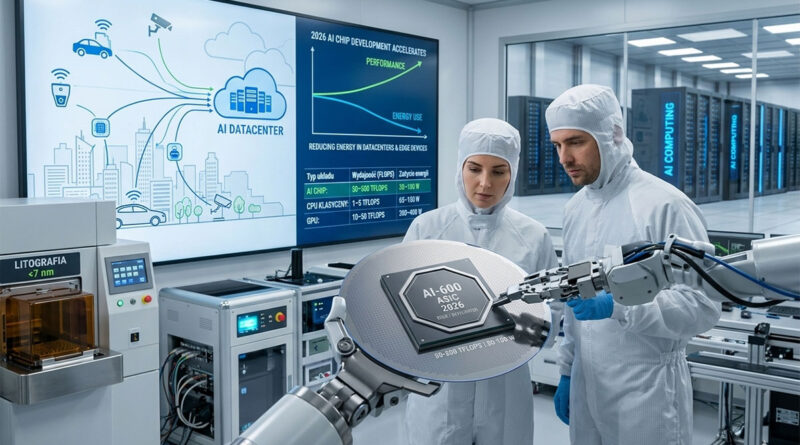
AI Chips: The Future of Data Processing in 2026
AI Chips – The Future of Data Processing in 2026
Modern Technologies in AI Chips
Comparison of AI Chips with CPUs and GPUs
Trends and the Future of AI Chips
Practical Applications of AI Chips
AI chips - the future of data processing in 2026
The development of AI chips in 2026 is accelerating and transforming the way data is processed across the entire technology industry. Modern integrated circuits not only increase computational efficiency but also significantly reduce energy consumption in data centers and edge devices. Unlike traditional CPUs or GPUs, AI chips are designed to quickly run machine learning algorithms and neural networks, making them an essential component of modern AI systems.
Modern technologies in AI chips
AI chip production relies on the latest technological processes, typically using lithography below 7nm. Such solutions allow for an increased number of transistors while reducing energy loss and heat generation. Engineers are designing units optimized for specific types of computations, such as matrix multiplications in neural networks or tensor operations used in deep learning.
In 2026, special emphasis is being placed on AI chips for edge devices (edge AI). These chips enable local data processing without the need to transmit it to the cloud, shortening system response times and reducing network load. At the same time, demand is growing for chips for autonomous vehicles, which must analyze signals from cameras, LIDAR sensors, and radars in real time.
Designers are also increasingly focusing on chip modularity and scalability. This means the ability to combine several units into larger configurations for data centers or AI supercomputers. At the same time, pressures for sustainability and energy efficiency are forcing innovation in chip design to minimize energy consumption and maximize performance.
Comparison of AI Chips with CPUs and GPUs
To understand the advantage of AI chips, it’s worth looking at how performance and energy efficiency compare in typical applications:
System Type
Purpose
Performance (FLOPS)
Power Consumption
Typical Application
Classic CPU
General-purpose Computing
1–5 TFLOPS
65–150 W
Servers, Personal Computers
GPU
Parallel Graphics and AI Computing
10–50 TFLOPS
200–400 W
Neural Network Training, 3D Visualization
AI Chip (ASIC)
Dedicated AI Computing
50–500 TFLOPS
30–100 W
Edge AI, Autonomous Vehicles, Data Centers
As you can see in the table, AI chips deliver significantly higher performance with significantly lower power consumption, especially for tasks involving machine learning and big data analysis.
Trends and the future of AI chips
In the coming years, AI chip development will focus on increasing performance and integrating with new types of systems. Edge AI enables local data processing in intelligent devices, and chips for autonomous vehicles will integrate multiple sensors and image processing algorithms in real time. The chip’s modularity allows for the design of flexible, easily scalable systems, and energy efficiency remains a key criterion in data center design.
At the same time, chips with specialized functions are appearing on the market, such as those for natural language processing, image recognition, and real-time physics simulation. The industry is also focusing on standardizing interfaces, which facilitates the integration of various chips into larger computing platforms.
Applications of AI chips in practice
AI chips are used in numerous industrial sectors. In medicine, they enable faster imaging diagnostics and genomic analysis, in the automotive industry they support autonomous driving systems, and in finance, they accelerate the processing of large amounts of transactional data and risk prediction.
Edge AI is used in intelligent surveillance cameras, drones, industrial robots, and smart city systems, where rapid analysis of local data is crucial. Thanks to their high performance and low latency, AI chips enable real-time process automation, minimizing the need to transmit data to the cloud.
The future of AI chips also includes developments in the areas of ecology and energy efficiency. Chip manufacturers are increasingly using semiconductor materials with a lower environmental impact and systems optimized to minimize energy loss.
AI chips are becoming the foundation of modern data processing systems. Their advantages over traditional CPUs and GPUs are evident in their performance, energy efficiency, and application flexibility. Trends for 2026 indicate that system development will focus on edge AI, autonomous vehicles, modularity, scalability, and sustainability. Industry professionals should monitor these changes as they impact AI implementation strategies in enterprises and research centers.
Bibliography
Patterson, D. A., & Hennessy, J. L. (2021). Computer Architecture: A Quantitative Approach. Morgan Kaufmann;
NVIDIA Corporation. (2022). NVIDIA AI Computing Overview;
Intel Corporation. (2022). Intel AI Product Portfolio;
Chen, T., et al. (2014). Diannao: A Small-footprint High-throughput Accelerator for Ubiquitous Machine-learning. ACM SIGARCH Computer Architecture News;
Jouppi, N. P., et al. (2017). In-datacenter performance analysis of a tensor processing unit. Proceedings of the 44th Annual International Symposium on Computer Architecture;
Li, X., et al. (2020). Edge AI: A Vision for Distributed AI Computing on the Edge. IEEE Internet of Things Journal;
Sze, V., Chen, Y., Yang, T. J., & Emer, J. S. (2020). Efficient Processing of Deep Neural Networks. Morgan & Claypool Publishers;
Li, H., & Ooi, B. C. (2021). AI Chip Technology Trends and Applications. ACM Computing Surveys.