Self-healing concrete – the development and importance of new technology
Self-Healing Concrete – How Microorganisms Transform Structures
Mechanisms of Action: How Concrete “Heals Itself”
Advantages of Self-Healing Concrete
Technological Challenges and Limitations
Experimental Research and Future Directions
Practical Applications and Implementation Potential
Self-healing concrete - how microorganisms change the face of structures
Self-healing concrete is a building material designed to independently repair micro-cracks that develop in its structure during use. In conventional concrete, even small cracks allow the penetration of water and aggressive ions, leading to corrosion of the reinforcement and deterioration of mechanical properties. This process shortens the durability of structural elements and generates high infrastructure maintenance costs. Self-healing concrete is designed to counteract these problems by reducing the rate of degradation and extending the service life of structures.
Self-healing technologies can be broadly divided into two areas: natural mechanisms, which utilize autogenous cement hydration processes, and autonomous self-healing systems based on microorganisms, which activate upon contact with moisture and produce natural minerals that fill cracks.
Concrete is the most widely used building material globally – annual cement production exceeds billions of tons – so any innovation that impacts its durability has a significant impact on the durability and cost of the entire infrastructure.
Mechanisms of Action: How Concrete "Repairs Itself"
Autogenous Self-Healing Processes
Concrete has a limited natural ability to partially self-seal microcracks, known as autogenous self-healing. This process is based on the reaction of water with unhydrated cement particles or the crystallization of calcium carbonate (CaCO₃). However, it only works in very narrow cracks (usually <0.3–0.5 mm) and is poorly effective in practice.
Microorganisms as Active Repairers: MICP
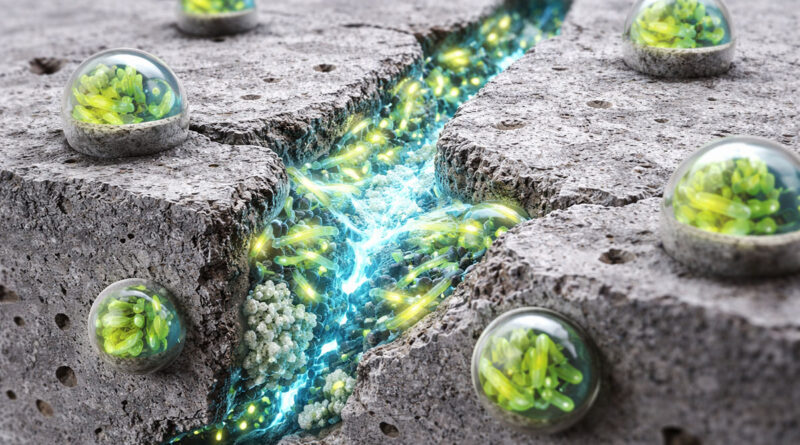
Much more promising are technologies using microorganisms capable of microbially induced carbonate precipitation (MICP). MICP is a process in which, under appropriate conditions, bacteria produce CaCO₃, which settles in and fills microcracks.
Bacillus bacteria and other ureolytic strains are most commonly used because they tolerate the alkaline environment of concrete and can produce the enzyme urease, which breaks down urea into CaCO₃ and ammonia. As a result, CaCO₃ crystals effectively seal microcracks, improving concrete’s integrity and delaying its degradation.
The review article indicates that introducing microorganisms into concrete can improve both the integrity and resistance of the material to aggressive environments, as well as positively impact its mechanical properties.
Advantages of Self-Healing Concrete
Improved durability and corrosion resistance
Self-healing concrete demonstrates reduced susceptibility to water and harmful substance penetration, resulting in delayed reinforcement corrosion and a longer service life. The presence of CaCO₃ in microcracks acts as a barrier to the penetration of chloride ions and carbon dioxide, which accelerate degradation processes.
Potential savings in maintenance costs
Traditional repairs to concrete structures are expensive and often require operational downtime. Microbial self-healing reduces the frequency and scope of maintenance interventions, which can lead to significant financial savings, particularly in bridge, tunnel, and industrial infrastructure.
Environmental Aspects
Cement production is responsible for a significant portion of global CO₂ emissions. Although self-healing concrete still contains cement, reducing the need for frequent repairs and new pours indirectly contributes to reducing greenhouse gas emissions throughout the structure’s life cycle.
Technological Challenges and Limitations
Environmental Conditions and Real-World Operations
Most research on self-healing concrete comes from laboratories and controlled experiments. Real-world operating conditions—fluctuations in temperature, humidity, and mechanical loading—can affect the effectiveness of self-healing. This is particularly true for microorganisms, which require appropriate moisture and conditions for activation.
Effectiveness with Crack Width
MICP mechanisms are most effective on small-width microcracks. Large structural cracks still require traditional repair methods, as biomineralization may not provide sufficient repair material in a single cycle.
Persistence of Bacteria and Carriers
Bacteria in concrete thrive in harsh conditions (high alkalinity, limited nutrient availability), and their long-term activity is the subject of research. Maintaining the viability of microorganisms or their carriers (microcapsules, matrices) in the long term is one of the most important technological challenges.
Costs and Standardization
The widespread introduction of self-healing concrete is associated with higher production costs and a lack of common construction standards to regulate its use. The construction industry has traditionally been cautious about new materials without long-term performance data.
Experimental Research and Future Directions
Experimental studies confirm the ability of microorganisms to increase microcrack bridging and improve impermeability and strength parameters. Some publications indicate that the use of specific strains can even improve compressive strength and water absorption resistance compared to control concrete.
Scientists are also conducting research on new carriers and methods for encapsulating microorganisms to improve their long-term activity and self-healing efficiency in real-world conditions. Furthermore, modeling and artificial intelligence techniques are increasingly being used to optimize concrete composition and microbial system performance.
Practical applications and implementation potential
Potential applications for self-healing concrete include:
- bridges and viaducts, where repairs are costly and difficult,
- tunnels and underground structures, where maintenance is difficult and expensive,
- water reservoirs and hydraulic structures, where concrete integrity is crucial,
- precast elements, which can benefit from additional durability.
Although the technology is not yet widely used in everyday construction, rapid research development and the interest of infrastructure investors indicate that self-healing concrete could become the standard in the future.
Self-healing concrete is a breakthrough technology that uses natural microbiological processes to autonomously seal micro-cracks and improve the durability of structures. Scientific research confirms that microorganisms can produce minerals that effectively fill cracks, resulting in improved corrosion resistance and longer material life. Despite technological challenges and cost considerations, self-healing concrete has the potential to revolutionize how infrastructure is designed and maintained.
Bibliography
H. S. et al., A systematic review of bacteria-based self-healing concrete: Biomineralization, mechanical, and durability properties, Journal of Building Engineering, ScienceDirect, 2022.
Self-healing bacterial concrete: A bibliometric overview and state-of-the-art review on fundamentals, techniques and future perspectives, Journal of Building Engineering, ScienceDirect, 2025.
“Smart” concrete based on microbially induced carbonate precipitation – A review, Construction and Building Materials, ScienceDirect, 2024.
Advances in microbial self-healing concrete: A critical review of mechanisms, developments, and future directions, Science of The Total Environment, 2024.
Self healing concrete based on different bacteria: A review, Materials Today: Proceedings, ScienceDirect, 2021.
S. Yehia et al., Bacterial self-healing and mechanical strength enhancement in concrete…, Innovative Infrastructure Solutions, Springer, 2025.